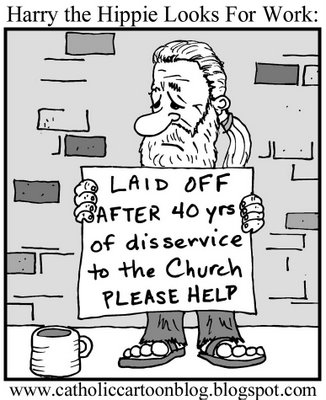
Oakland Cathedral (yuk)


Shrine of the Most Blessed Sacrament, Hanceville, AL (yeah)





FROM THE PASTOR:
Another aspect of our human life is the work we do in sacred worship. The Holy Sacrifice of the Mass is also called the Sacred Liturgy. His Holiness Pope Benedict XVI has set the stage for a renewal and renaissance of Catholic worship. This was the intention and objective of the Council Fathers at Vatican II. As mentioned before, we will be learning and using some Latin for common parts of the Mass on one weekend a month. The first Sunday (and evening before) in Marysville and the last Sunday (and evening before) in Duncannon, we will be using the Kyrie (Greek: Lord Have Mercy), Gloria (Latin: Glory to God), Sanctus (Latin: Holy, Holy), Pater Noster (Latin: Our Father), and Agnus Dei (Latin: Lamb of God). They are found in #862-869 of the large Music Issue of Today’s Missal. 'Catholic' comes from the Greek word katholikos which means 'universal' One obvious and poignant way to demonstrate the universality of our church is to use a universal language as well as our own vernacular.
If you watch the TV Mass on EWTN, you will be familiar with these. Even though only once a month, we will become more comfortable and familiar with our rich patrimony. Eastern Orthodox Americans speak fluent English yet use plenty of Greek in their weekly worship just as Jewish Americans use Hebrew in theirs. Latin is the official and traditional language of the Roman Catholic Church and coexists with the vernacular.
Once a month we will also utilize one of the options afforded the celebrant. Every priest is allowed to celebrate Mass facing the people (versus populum) or facing the Tabernacle (versus apsidem). I will do the latter once a month so you can appreciate and experience one of our beautiful customs going back to antiquity. Originally, all priests had to celebrate the Sacred Liturgy AD ORIENTEM, i.e., facing east. Churches were literally built so that the priest AND congregation both faced EAST during public worship. The reason was that the sun rose each day in the east. The Son of God rose from the dead on Easter morning, when the sun rose in the East. Hence, Christians were keen to respect that by facing east when they worshipped their Lord and Savior. Churches were built from Ancient to Mediaeval times facing east. The priest was not seen as ‘turning his back’ on the congregation, rather, BOTH priest and congregation were facing east TOGETHER. Does the bus driver or airplane pilot have his/her back toward the passengers OR rather is he/she facing the same direction of the destination everyone hopes to arrive at?
One of the dangers of exclusivlely celebrating Mass versus populum (facing the people) is that the Celebrant may be tempted to see himself as performing for the congregation. He is not on stage as an actor nor is a director or conductor guiding those in the audience. He is a LEADER of prayer and leaders POINT in the right direction. Great Generals led their armies in battle and both faced the same direction to victory. When the priest and the people both face the same direction, they are also doing the same thing, i.e., worshipping God.
The Greek and Russian Orthodox Churches, the Byzantine Catholic Churches, and many Lutheran and Anglican churches have worship services where the celebrant faces east with the congregation. Where it is geographically impossible to face east (ad orientem), the custom arose for the priest and people to face the Tabernacle (versus apsidem) since that is where the Body & Blood, Soul & Divinity of Christ was always present. Facing the Blessed Sacrament was in essence facing east since the east symbolized the Rising SON (and not just the rising SUN). Therefore, once a month, I shall celebrate Mass facing the Tabernacle, just as you do every time you sit in the pews. WE will be facing the same direction TOGETHER and not me turning my back on you as some would erroneously claim. It is only once a month but I think it important to do since it is part of our legacy, it is done all the time in the Extraordinary form of the Roman Rite (Tridentine Mass) and it is a valid and licit option in the Ordinary form (Novus Ordo or Vatican II Mass). The Scripture readings and homily will still be given facing the people since they are directed toward you. The prayers of worship directed toward God, however, will be facing Him as He IS present in the Tabernacle. Just as we have a diversity of music and language, we have a diversity of proper liturgical forms as part of our Catholic heritage. We should embrace the fullness of whom we are and how we worship.


.- The
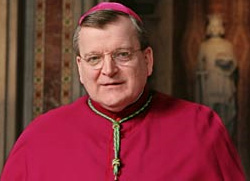
prefect of the Apostolic Signature, Archbishop Raymond Burke, said this week
that Catholics, especially politicians who publically defend abortion, should
not receive Communion, and that ministers of Communion should be responsibly
charitable in denying it to them if they ask for it, “until they have reformed
their lives.”
In an interview with the magazine, Radici Christiane, Archbishop Burke
pointed out that there is often a lack of reverence at Mass when receiving
Communion. “Receiving the Body and Blood of Christ unworthily is a sacrilege,”
he warned. “If it is done deliberately in mortal sin it is a sacrilege.”
To illustrate his point, he referred to “public officials who, with knowledge
and consent, uphold actions that are against the Divine and Eternal moral law.
For example, if they support abortion, which entails the taking of innocent and
defenseless human lives. A person who commits sin in this way should be
publicly admonished in such a way as to not receive Communion until he or she
has reformed his life,” the archbishop said.
“If a person who has been admonished persists in public mortal sin and
attempts to receive Communion, the minister of the Eucharist has the obligation
to deny it to him. Why? Above all, for the salvation of that person, preventing
him from committing a sacrilege,” he added.
“We must avoid giving people the impression that one can be in a state of
mortal sin and receive the Eucharist,” the archbishop continued. “Secondly,
there could be another form of scandal, consisting of leading people to think
that the public act that this person is doing, which until now everyone believed
was a serious sin, is really not that serious - if the Church allows him or her
to receive Communion.”
“If we have a public figure who is openly and deliberately upholding abortion
rights and receiving the Eucharist, what will the average person think? He or
she could come to believe that it up to a certain point it is okay to do away
with an innocent life in the mother’s womb,” he warned.
Archbishop Burke also noted that when a bishop or a Church leader prevents an
abortion supporter from receiving Communion, “it is not with the intention of
interfering in public life but rather in the spiritual state of the politician
or public official who, if Catholic, should follow the divine law in the public
sphere as well.”
“Therefore, it is simply ridiculous and wrong to try to silence a pastor,
accusing him of interfering in politics so that he cannot do good to the soul of
a member of his flock,” he stated.
It is “simply wrong” to think that the faith must be reduced to the private
sphere and eliminated from public life, Archbishop Burke said, encouraging
Catholics “to bear witness to our faith not only in private in our homes but
also in our public lives with others in order to bear strong witness to
Christ.”
The Confraternity of Catholic Clergy unequivocally supports His Grace in this unambiguous response to those Catholics who support abortion and still approach the Sacred and Most Holy Eucharist. We are proud to have been called the "Burke Brigade" last year in the secular press when we visited the Archdiocese of St. Louis. God save and bless Archbishop Burke.