Tuesday, September 25, 2007

Sacerdotal Tepidity and Ministerial Malaise: The Spiritual Cancer of Lukewarmness

One of the most immanent yet diabolically latent threats to the priesthood is not the recent clergy sex scandals nor the alleged vocation crisis. The real, critical and urgent danger to many priests, whether young, old or middle-aged, is business. The current paradigm many parishes and dioceses use is a corporate business model in which the priest (or deacon; pastor or parochial vicar) defines his identity in what he does and not in what he is. Doing things, i.e., performing tasks, becomes the primary directive after ordination and it is the measure by which priests are evaluated by their superiors, their peers, their parishioners and even by themselves.

It is self-evidently true that a vocation to ordained ministry involves, entails and surrounds itself with service to the Church and to the People of God. Just as Our Divine Lord came not to be served, but to serve, deacons, priests and bishops are poignantly reminded at their ordination that they are called into a lifetime of self-sacrificing service. Nevertheless, there is a corresponding truth to this commitment to minister that in recent times has been overlooked, ignored or even opposed. The minister must minister unto himself as well as to his people. An effective and successful priest ministers to the spiritual needs of his people but he also takes care of his own spirituality, too.

Every cleric knows the importance and the obligation of prayer. The problem is when prayer becomes another ‘task’ to be performed. The canonical duty of praying the Liturgy of the Hours is morally binding on all in Holy Orders. All too often, though, the temptation arises to see and to do the Breviary as another job that needs to be done: celebrate Mass, hear confessions, visit and anoint the sick, teach RCIA and/or CCD, prepare a couple for marriage, prepare the Sunday homily, attend the Parish Council meeting (and the Finance Committee, and the Parents and Teachers Association and the Council of Catholic Women, etc.), and of course, get ready for the next parish fundraising event.

Most parish priests have the same routine day after day, i.e., they balance catechesis with sacred liturgy with administrative duties. Important work, by all means. Doing priestly things is very important but so is being priestly. Why do some priests burn out and leave active ministry after ten, twenty or more years? Why is priestly morale low in many dioceses? Why do some clergy seek artificial relief in escaping into sex, alcohol, gambling, etc.? The reason for many is that they never took good care of their own spiritual health.

Unless one is an workaholic, most priests faithfully take their weekly day off and their annual vacation. Many, though, cheat themselves and do not take the full day off (24 hours) and will only go away for half a day or skip a few weeks entirely. Some almost never take time to relax and unwind and their parish office staff often suffer for it. Irritable pastors are usually ones who rarely get away and without healthy leisure and regular relaxation, anyone can become a cranky bear who growls at everyone over anything.

The other phenomenon is the dearth of spirituality among the priesthood in general. Yes, most of us pray the Office each day, celebrate Mass reverently and attend to the myriad and plethora of needs of our parishioners while simultaneously trying to keep up with diocesan policies, regulations and other bureaucratic requirements that seem to multiply geometrically. But how many of us take and make time for quality prayer? The American Bishops issued an excellent document in 2001 entitled The Basic Plan for the Ongoing Formation of Priests which was based on the mandates of the Second Vatican Council (Presbyterorum Ordinis, 1965) which called for ongoing post-ordination formation of the clergy. Pope John Paul the Great reiterated this in his Pastores Dabo Vobis and spelled out precisely by the Congregation of the Clergy in The Directory on the Ministry and Life of Priests (1994).

Ongoing spiritual, theological, pastoral and human formation of the clergy is no option. It pertains and applies to the clergy since it enables the clergy to become better clergy and thus better minister to the People of God. Without ongoing formation, clergy become mere functionaries who perform tasks and who ‘do their job’ and know well what they do while slowly forgetting who they are. A priest is an alter-Christus who acts in Persona Christi. He can only act in the Person of Christ by virtue of his sacred ordination that ontologically changes him.

The corporate business model is no better than a mediaeval feudal model. The Church is more than a corporation and even in her role as institution, she always remains the Bride of Christ. Part of the horror of the clergy sex scandal was the way in which some bishops handled (or rather mishandled) the situation. Administrators can transfer personnel but a spiritual father must confront wayward children, both the victim and culprit. Justice tempered by mercy and motivated by charity would have spared many a nightmare whereas bureaucrats who seek merely to avoid legal liability are not serving the common good. When bishops and priests acts like the Church is truly a family of faith by acting like family themselves, the people respond tremendously. When clergy act like coporate officials and make decisions based on fiscal rather than pastoral needs; when pastors are treated and act more like lower middle management instead of local leaders of the faith community; then trouble is not far behind.

The priest himself, however, can be his greatest ally or his worse enemy. No matter how orthodox and pastoral the local bishop may be, the priest himself must minister to himself before he can effectively minister to his people. Bishops and Dioceses are beginning to recognize the necessity of ongoing formation of the clergy but the priest himself must also see and pursue it. If a priest is ‘too busy’ with parish work to make sure he himself gets quality time for daily private prayer, for regular confession, for monthly spiritual direction, and for an annual workshop, then his priorities are askew. A husband and father who functions as head of the family needs to take care of himself in order to best provide for his loved ones. That means that dear old dad must take care of his own physical and spiritual health and not just attend to financial matters by working longer hours and getting more pay. Likewise, a spiritually healthy pastor is more effective pastor.

This is why JP2 wrote Pastores Dabo Vobis in 1992. The priest is not an employee of the diocese nor is he branch manager or local sales representative. He is the loving spouse of his bride, the Church. His parishioners are not customers or clients, rather, they are his beloved family. Corporate business models do not fulfill the spiritual reality of authentic ecclesiology. Fiscal solvency may look good on paper, but a good pastor is doing a good job when souls are being saved. Many pastors easily fall into the temptation of evaluating themselves on the basis of how many parishioners did they gain or lose; did the weekly collection go up or down; is the parochial school enrollment increasing or decreasing; is the parish in the red or in the black; are parishioners happy or dissatisfied? All these can eclipse the real mission of a pastor, to preach and teach the unadulterated truth as authentically taught by the Magisterium and to reverently and properly celebrate the sacred sacraments so as to fully dispense the divine graces needed by the People of God. Eight to twelve years of seminary formation are designed around the latter while the former often become the primary directive of many pastors.

Despite the efforts of local bishops and dioceses as well as national and regional priestly associations to foster ongoing formation and sacerdotal fraternity, too many priests of all ages get caught up in the administratrive treadmill or they fool themselves into thinking that doing priestly things is more important than being a priest. Being a priest involves sacrifice. Sometimes it means the sacrifice of failure insofar as a plan, a project, a program, etc., despite the good intentions, just flops. No one attends. No support. Since we live a secular society which divinizes success, no wonder then it spills over into spirituality. Even priests seek to be successful but it cannot be as the world defines success. A successful priest is not the one who gets the best assignment, or is the bishop’s confidant. He may not be the one who is on any diocesan committee, board or council. He may not have been named a Monsignor or Papal Knight. He may get an occasional letter of complaint from some irate parishioner who is ignorant of canon law and tried to get a non-practicing divorced and invalidly married Catholic to be godparent to their newborn child. The truly successful priest will from time to time make some enemies if he preaches and teaches the truth and nothing but the truth. He will not be the favorite of the Chancery nor the most popular of parishioners. He will, however, be kind and compassionate and yet will also defend the teachings and the honor of Holy Mother Church.

Wordly success in the ministerial life is illusionary. Being pastor of the most enviable parish in the diocese or having great influence and connections with diocesan officials is not the real measure. Balancing the checkbook, lowering the debt, increasing enrollment are not bad things in and of themselves, for they show good stewardship for sure, yet, they should not become the priority of pastoral concern. Saving souls for Christ is what we will be judged on when we die, not the fiscal solvency or the number of buildings we erected during our tenure.

There is a new phenomenon where many good, solid, orthodox priests are still getting lost. They are not preaching heresy nor teaching dissident theology. They celebrate reverent Masses and follow the rubrics. They follow the rules of canon law and diocesan policy. They attend to the spiritual needs of their parishioners any day and any time. The problem lies in that many of them feel abandoned. Since the clergy sex scandals, people are more suspicious and some are just downright more rude and certainly less polite. Parishioners who rarely come to Mass and who barely support the church with their time or treasure often are obnoxious and beligerent in their demands especially when they cannot be fulfilled. It can be disheartening and disenchanting when unfounded rumors and gossip fly through the parish merely because a mediocre or lapsed Catholic has a grudge against the pastor when he upholds the disciplines or teachings of the Church. “No good deed goes unpunished” is often a colloquialism felt by many a parish priest when day in and day out the struggle is made to do the best you can do for others only to have them show disdain and contempt for your every effort. That could be tolerated if a two front war were not in play.

Frequently, priests must battle with foes inside the parish and outside. One or two squeaky wheels will get a response from downtown which is to be expected, of course. What is not anticipated, however, is the unconditional acceptance of their side of the story. Often, the priest, especially if he is the pastor, is considered guilty until proven innocent. While any and all credible allegations of abuse must be investigated, petty complaints which do not involve faith or morals, are sometimes treated as if the priest were a criminal before he even hears what he is accused of doing. Real instances of liturgical abuse go unfettered, real examples of heterodox teaching being proliferated and real occurences of immoral behavior among the clergy and yet who is called on the carpet by diocesan officials? Not those guilty of serious offenses, rather, the poor pastor or priest who stepped on the toes of an influential person of the parish or diocese.

When an apparent double-standard exists within the diocese, a good priest can easily get discouraged. He can tolerate the persecution of those who hate the Church and vehemently seek her ruin and demise. He can even bare wrongs patiently and remain obedient and respectful as long as there is no sign of duplicity or treachery. Yet, when it sems that being a loyal son of the Church gets you in hot water even with some officials in the Church, it can be very disconcerting to say the least. Only a solid, well grounded and bedrock spirituality will help these priests.
This is why all priests must aggressively take charge of their own spiritual health. The Bishop and Diocese can and ought to help by making it more convenient to get to regular confession and monthly direction just as they do for annual retreat. Days or even mornings or afternoons of reflection or recollection are most beneficial but they require proper planning.

A priest friend of mine sponsors a monthly afternoon of recollection for priests and deacons. Each month, a visiting priest (from the Personal Prelature of Opus Dei) comes for two to three hours. He gives a spiritual meditation/conference based on Scripture, Papal or Conciliar document. There is time and opportunity to go to confession. The Blessed Sacrament is exposed for adoration. The rosary and evening prayer are prayed before Benediction. Then there is some time alloted for fraternity, be it a small snack or perhaps a few guys going out to supper. Just an informal gathering once a month. Sadly, in a densely populated area where many orthodox and devout priests are less than an hour to forty five minutes away by car, many parish priests do not attend. Their reason? I am too busy. I have parish commitments. When your tooth aches, do you not make time to get to the dentist even though you still have plenty to do in the parish? If Father is sick in bed, he cannot do his parochial duties. Hence, priests need to tend to their physical health and well being. Likewise, our spiritual health is even more important.

Too many priests have fooled themselves into thinking that doing priestly things compensates for being a priest by taking care of my own spiritual needs. Canon Law mandates an annual retreat. Dioceses have mandatory workshops. What is wrong with making time for a monthly day or even just a morning or afternoon of recollection? A few hours with brother priests and deacons spent in prayer, study and fraternity will revive and revitalize our apostolate. The Confraternity of Catholic Clergy has continued its more than thirty year history of sponsoring an annual convocation where well known and reputable speakers, both ordained and laity alike, have given excellent talks on timely topics suitable for the typical parish priest. This organization has over six hundred members from across the USA and Canada. Less than fifty attend the annual conference. Whether East Coast or West Coast, whether Saint Louis or Chicago, the venue and the speaker roster, even the cost do not become the primary reason more do not attend. Bottom line is that most guys are too busy.

What is frightening is that many believe that. Catholic Clergy, be they deacons, priests or bishops NEED to take care of their spiritual needs. Daily prayer we usually do faithfully as we were trained to do so in the seminary. Many priests have not gone to spiritual direction, however, since they left the seminary. Many priests only rely on the annual penance service during Holy Week (usually on the same day of the diocesan Chrism Mass) to get to confession themselves. We hear confessions of our parishioners week after week. We, too, need to avail ourselves of the graces of this awesome sacrament. Since we are in the confessional hearing other people’s confessions, it is logistically difficult for parish priests to get to confession, no doubt about it.

This is why it is most urgent and helpful were the local diocese to take ongoing spiritual, theological, pastoral and human formation of the clergy as serious as possible. Next to vocations, it should be of utmost importance. Diocesan workshops are indeed helpful but so, too, are the many offered year round by priestly associations, organizations, etc. Ironically, even dioceses that do not have mandatory workshops still budget funds so that any and every priest can theoretically attend a conference somewhere sometime during the calendar year in addition to his annual reatreat. Though the money and time are guaranteed, too many clergy say they are ‘too busy’ to get away. Here is where the Bishop and diocese can help. Not only in providing the financial means to go, but to ensure coverage so the pastor can get away. One week annual retreat and one week annual workshop (conference or convocation) can be achieved if the Chancery Office made the promise to find adequate sacramental coverage.

Monthly spiritual direction after seminary is rare but it can and ought to be done. While in seminary, the spiritual directors are in house and it is easy to accomplish. Post ordination, the seminary and the director are often far away and not conveniently located. Those who can drive to a nearby seminary may find a spiritual director available but the majority of priests are not so lucky. Again, the local bishop and diocese can help by recruiting several reputable spiritual directors and providing for their transportation, and at least make the opportunity available for monthly direction. Imagine, flying in five or six spiritual directors once a month and staggering it over a few days each month. While not everyone will or can participate, at least some will and some is better than none. Knowing that a spiritual director is available once a month or at least every two months is encouraging to a priest who lives too far to get to his old seminary.

Days, mornings or afternoons of recollection can be done easily. What it takes, though, is perserverance. Perhaps, if the Bishop initiated a few or advertized several in diocesan mailings, more fellows would attend. Two or three hours a month is nothing to ask in comparison to the nearly 700 hours a month that are spent on other things we priests do. We find time for the dentist, to get our auto’s oil changed, to get to the barber, to grab a bite to eat, etc. We need to make time for our spiritual life and get to confession reguarly (once a month), monthly or bi-monthly spiritual direction and annual retreat and annual workshop or conference.

If priests knew and saw the bishop doing these same things, he would get the notion that they are important essentials to spirital life. Private prayer, rosary, Liturgy of the Hours and annual retreat are already being done by many priests. The few who do not, do so at their own risk. What is needed besides wonderful documents from Pope and the Bishops, is an all out campaign at the national and local level to reawaken the clergy as to the importance of all these spiritual exercises. Optimally, if several diocesan priests could live in community as a Clerical Association of the Faithful, they could hopefully provide the occasional sacramental coverage so their brother priests in the diocese could take time away for retreat, spiritual direction and workshops. This same community could also be the focus point where any and all priests are welcome to spend some time in fraternal prayer, meals, study, or just relaxation.

When many priests are now in one man assignments, it is imperative for parish priests to have some avenue of fraternity which is obviously in-built with those in religious life who live in common. Most priests live, work and eat alone as priests even though they have very busy and hectic schedules. Here is where priestly fraternity is even more beneficial. If every diocese had what the Directory recommends (a house of clerics) where any priest could crash for an afternoon or evening, spend a day or overnight, share a meal with brother priests, watch a game on television, pray one one of the Hours together, engage in a stimulating theological discussion, etc., it would not have to be elaborate, fancy or luxurious. Just a friendly place where brother clergy can be brothers to one another.

It is too important to just hope and pray that individuals will take care of all the details themselves. We need the support and encouragement of the episcopal conference, the local bishop, and the diocesan presbyterate itself. National associations like the Confraternity of Catholic Clergy, the Fraternity of Priests, and projects sponsored by the Prelature of Opus Dei and others can provide some viable avenues. If too many of us become too busy doing things and do not spend quality time being priests and being priests to and for one another, we will see more guys burn out, get discouraged and see morale decline over time.

While no one seeks public approval, what priest does not internally want at least the implied support of his bishop? When politics determines who becomes a Monsignor or who is made a Papal Knight, those outside the loop get no enouragement. There does not have to be an award dinner, either, where someone gets ‘pastor of the year’ award, yet some vehicle of affirmation would help morale if it were completely sincere and authentic. Once I suggested to my previous bishop that he take a young and an old priest along with him every time he went on his ad limina to Rome. No Chancery personnel, but just a parish priest, be he a pastor, parochial vicar or retired priest. Spending a few days with the boss in the Eternal City is more than an employee recognition opportunity. The bond between bishop and priest is special and when a priest experiences the acknowledgement that his bishop appreciates his work, it will help him in the weeks, months and years to come when he may feel alone or get a angry letter or phone call from a dissatisfied parishioner. If the bishop regularly spent one meal a month with a different priest, just man to man, priest to priest, would not the morale be strong?

All too often the parish priest only hears from his superiors when someone has written or phoned a complaint. Obviously, serious concerns and issues need to examined for the common good of Mother Church. At the same time, if a phone call or e-mail from His Excellency comes to the priest occasionally expressing personal approval and support, the esprit de corps of the presbyterate will be high. Even the annual Bishops’ meetings in November, if the local bishop brought along a different priest (not just to carry his luggage) each and every time, not only to see how things work at the national level but to just spend time with spiritual leader of the diocese, I think better relations would exist throughout the diocese. If only cronies and syncophants are part of the inner sanctum and if only the politically astute get promotions, then a different attitude permeates the diocese.

Priests are called to serve and to love their people. He can do so only if he himself is taking care of his own spiritual needs. Prayer, study, priestly fraternity, support and encouragement from his peers and his superiors, will all help. Ongoing formation of the clergy entails exposure and discussion on recent Vatican documents and statements, attending workshops and conferences, and having access to keen minds faithful to the Magisterium. It also entails solid spirituality grounded in daily private prayer, regular confession, monthly direction and annual retreat. Having places and opportunities to spend some time just being and enjoying being priests with brother priests might prevent some of the sad incidents where a few brethren have gone astray. Perhaps some would have avoided dangerous and ill advised behavior had there been a better alternative accessible. If we priests do not take care our ourselves and of our brethren in Holy Orders, we will not be at our best to serve the faithful we pledged and committed ourselves to for the rest of our lives the day we were ordained. The People of God deserve nothing less than the best we have to offer, not just in the work we do but also in the person and the priest we are.

Tuesday, September 18, 2007

Motu Proprio

I was ordained in 1988, the Marian Year. Within six months of my assignment as parochial vicar, I sent a formal application to the Ecclesia Dei Commission asking for faculties to celebrate the Tridentine Mass. Before the end of the calendar year, I was informed that Rome no longer granted these but that the request needed to be sent to the local ordinary. Year after year I asked my diocesan bishop and year after year it was ignored. Even a request for Byzantine faculties (Ruthenian church) was overlooked.

His Holiness Pope Benedict XVI changed everything in 2007 through his motu proprio Summorum Pontificum. Deo gratias, priests and laity who love and appreicate the extraordinary form can get spiritual nourishment and sustenance. I also love the ordinary form when done properly, as at EWTN. The use of Latin and celebrating ad orientem is not limited to the ancient use.

As I mentioned on the EWTN Roundtable Discussion, Pope Benedict aptly described Catholicism as the religion of the great "et ... et" (Latin for BOTH ... AND) as opposed to other faiths which are primarily exclusive, the 'aut ... aut' (EITHER ... OR). Catholicism tends to synthesize and hence we have BOTH Sacred Scripture (Bible) AND Sacred Tradition as sources of Divine Revelation; BOTH faith AND good works as necessary for salvation; BOTH the Western (Roman Rite) AND Eastern (Byzantine Rite); and now, thanks to B16, we have BOTH the extraordinary form (Missal of 1962; Tridentine Mass) AND the ordinary form (1970 Missal; Novus Ordo of Paul VI) of the one Roman Rite.

Since it is BOTH the extraordinary form AND the ordinary form, neither one is inferior to the other. Both are valid and licit. Both will enhance each other, as Fr. John Zuhlsdorf of What Does The Prayer Really Say commented in his erudite observation. He sees both forms as having a 'gravitational pull' on each other so that mutual appreciation for reverence, adherence to proper observation of the rubrics, and dilgent care that these celebrations edify and inspire those who attend to aspire in their spiritual lives to truly seek and live HOLINESS and SANCTITY. Liturgical worship is primarily giving praise and adoration to God but secondarily it is giving encouragement and strength to believers so they can incorporate the sacred mysteries of faith into their daily living. KNOWING the faith comes from catechesis; GROWING in the faith comes from prayer and spirituality, especially the Sacraments and the Sacred Liturgy; LIVING and PRACTICING the faith comes from living morally good lives and performing the spiritual and coporal works of mercy as often as possible.

There is no contest between the two forms. The ordinary form is such because most Catholics today know and are familiar with the Novus Ordo as they were too young to remember the older form commonly called the Tridentine Mass. Nevertheless, in calling it the extraordinary form, Pope B16 is not making it a second class type of worship. In fact, his letter requires pastors and bishops to do what they can whenever the faithful express their need and desire for the ancient form, be it the Mass or even the other Sacraments. Like the Eastern Rite Churches in union with Rome, their people deserve equal treatment and equal access to their traditions. Yet, they may participate in Western liturgies and vice versa. Similarly, Roman Rite Catholics can attend Byzantine liturgies or the extraordinary or the ordinary form of the Mass in the Western Church.

Without mixing or assimilating rites, all valid and licit liturgical traditions and rituals only enhance our CATHOLICITY (universality). Eliminating liturgical abuses, innovations, and other aberrations will hopefully result in the demise of the infamous Liturgical Nazis who for the past four decades raped our churches and sanctuaries of real Catholic art and music and replaced them with pedestrian and banal noise, space and activity. We can have a real Liturgical Renaissance thanks to Pope Benedict and his motu proprio.

Tuesday, May 22, 2007

Response to 18 Catholic ? Democrats

FOR IMMEDIATE RELEASE

MEDIA ADVISORY
Catholic PRWire

Dear Legislators,

MARYSVILLE, PA, MAY 22, 2007 - Your letter of May 10th is self-incriminating. While criticizing the Pope for doing his job as supreme pastor, you yourselves betray your own duplicity as Catholic lawmakers. The supreme pastor of the universal church has jurisdiction over every Catholic Christian in the world. Canon Law makes it clear that every baptized Catholic is under the authority of the Church in matters of faith and morals. Hence, when the Roman Pontiff upholds and enforces the Divine Positive and the Natural Moral Laws, he is not interfering with man-made civil law, rather, he is reminding you of its subservience to the higher laws to which it must conform for the common good of all.

Canon 1398 states that “a person who actually procures an abortion incurs a latae sententiae excommunication.” Anyone who supports abortion is a formal cooperator in evil while those who ‘personally oppose abortion but uphold a woman’s right to choose abortion’ are material cooperators in evil. When he was still Cardinal Ratzinger, Pope Benedict sent a letter to the US Bishops in 2004 which said “a Catholic would be guilty of formal cooperation in evil, and so unworthy to present himself for holy Communion, if he were to deliberately vote for a candidate precisely because of the candidate's permissive stand on abortion and/or euthanasia.” He also said that Catholic politicians who consistently campaign and vote for permissive abortion and euthanasia laws are formal cooperators in evil and they are “not to present themselves for Holy Communion.” Our words and actions make us worthy or unworthy. Church law merely ratifies our decision by telling us to refrain from Communion when we should not be taking it.

The Pope has the right, the obligation and the duty to enforce the moral law, which is superior to all municipal, state, federal or even international law. The Nuremburg trials proved that when Nazis were convicted of the heinous evil and injustice of genocide despite the apparent civil legality at the time. The government enacted immoral laws which society and decency said should never have been upheld or enforced.

Your letter insinuates that the Bishop of Rome is interfering with American jurisprudence. He is not. Pope Benedict is merely reminding Catholic Americans that their first and foremost loyalty is to God and the common good. Any and all civil laws which contradict the Divine and/or the Natural Law are invalid and have no obligation upon anyone. If that were not the case, then slavery, segregation and anti-Semitism would have to be tolerated if some legislature or court upheld laws supporting these atrocities. Thankfully, even the evil of apartheid is finally gone though it had been legal for centuries in South Africa.

Learn from history and remember that it has usually been religious people of faith who have convinced lawmakers and judges that immoral laws must be abolished no matter how ‘constitutional’ they may appear. Our inalienable rights do not come from any document, not even the Constitution nor are they bestowed upon us by any government. The right to life comes from the Creator and once given, it cannot be unjustly taken away. The unborn children murdered by abortion have had no due process yet their civil rights have been denied them. Even though they are in their mother, the unborn are no more ‘property’ than was any slave. No one owns another human being, whether in the womb or out of it.

On the one hand you state “advancing respect for life and for the dignity of every human being is, as our church has taught us, our own life’s mission,” yet you remonstrate the spiritual leader of our one billion member church simply because he reaffirms the innate evil of abortion. How can you advance ‘respect for life’ and the ‘dignity of every human being’ without a complete and total ban on all abortions? Reducing abortions and providing moral alternatives, like adoption, are very laudatory, but they are not enough.

All abortions must be outlawed and Roe v. Wade needs to be overturned once and for all. Would abolitionists and African-Americans been satisfied if slavery had merely been ‘reduced’ rather than abolished? Of course not. Though shamefully our nation legalized slavery at one time, limiting and reducing an immoral evil and a civil injustice was not enough. Even though the Supreme Court issued their infamous Dred Scott and (1857) and Plessy v. Furguson (1896) decisions, slavery and racial segregation remained unjust, evil and immoral, despite their apparent ‘legality’ by the highest court of the land. Likewise, Roe v. Wade (1973) may have ‘legalized’ abortion across the land, but its inherent injustice to the unborn human child remains a moral and civil evil upon our country.

Catholics, whether politicians, judges or voters, need to act responsibly. If they give direct and proximate material cooperation in evil, from abortion to euthanasia, then Divine Law, Moral Law and Canon Law say they are ineligible for Holy Communion. You do not need an official excommunication, either. Hopefully, more bishops and pastors will remind their people and enforce this so as to discourage any and all cooperation in these moral evils.

Rev. John Trigilio, Jr.
President

Sunday, November 19, 2006

If Ye Be Lukewarm I Shall Vomit Thee Out of My Mouth

A growing phenomenon among the faithful clergy is a potential pandemic of spiritual APATHY. Many of us who had to fight long and hard for many years just to get ordained, who suffered and were persecuted for our orthodoxy and our loyalty to the Roman Pontiff and the Magisterium, have now hit middle age. In our youth, we fought the heretical professors, we did battle with the dens of iniquity which tried to indoctrinate us into the false religion. As newly ordained junior clergy, we stood up to the old liberal guard who ran the parishes and chancery offices. We declared our loyalty to Pope John Paul II, the 1983 Code of Canon Law and to the actual rubrics of GIRM. We then had the Catechism to defeat the status quo of the catechetical elite who proliferated the church as DRE's and who deified existentialism as the savior of catechetics while they simultaneously pooh-poohed doctrinal formation and memorization.

During seminary days (which many of us referred to as the Russian Siberian Gulag or Nazi German Stalag 13) we had a common enemy, heterodoxy. Like Christians in third century Rome or Catholics in Elizabethan England, we strategically remained undercover while clandestinely studying the truth from outside sources like Opus Dei. After being ordained and surviving the first parish assignment, usually with one of the most liberal pastors of the diocese, many of us longed for the day we would be pastor ourselves and finally could do what had to be done and do it the proper way according to canon and liturgical laws.

After ten, fifteen or more years for many of us, they could no longer delay the inevitable and we were made pastors and could now call the shots so to speak. When we were younger and more idealistic and less cynical, we went to our annual Opus Dei priest retreats at Arnold Hall. We subscribed and read orthodox periodicals like 30 Days, Catholic World Report, National Catholic Register and of course, the bedrock Wanderer. We cheered when Mother Angelica dumped the modified habit after the Miss Youth Day impersonated Christ at a living Stations of the Cross performed in Denver for the late Pope John Paul the Great. We watched attentively as the Poor Clares in Irondale donned the wimples and full veils and sang like angels as they chanted the familiar Latin parts of the Mass as Vatican II had originally envisioned.

Middle age does something to men. Laymen, especially married men, often experience a crisis and need to act out some stupid immature fantasy, whether it is buying a flashy red sportscar he cannot afford, or getting married on the spur of the moment at a Chapel of Love in Las Vegas or in the extreme of abandoning a wife and children for some bimbo he met on a chatline via the internet. Mid-life crisis they call it. Priests are not immune to it. Some, run off an marry a divorcee with children, a few sadly run off with the church organist (and it ain't a she if you now what I mean). Others take an indefinite sabbattical and no one hears from them again.

A majority of middle-aged clerics just get into a slump. Their zeal and fervor have been tempered over the decades by diocesan policies and parish soap opera antics. Increasing fundraising, tedious and incessant meetings, enormous budget concerns, personnell problems, psychotic parishioners, incompetent volunteers, unrealistic and severe assessments, et al. rob your priestly soul of the original dream you had when you decided to enter the seminary and began dreaming of BEING a priest. We still DO priestly things like celebrate Mass, hear confessions, anoint the sick, hatch-match-and-dispatch (baptize, marry and bury), etc., which we love to do, but our days get more and more infected with managerial tasks which are governed by corporate principles and techniques. Increase prodcutivity is what is demaned from us, not saving souls, not dispensing God's grace via His sacraments or teaching the truths of revelation.

Worse of all, I can see in many of my colleagues the slow, slow death of their enthusiasm for the priesthood. When the bishop and diocese see and treat you as lower management and when you see incompetent sycophants rewarded with promotions, good assignments, ecclesiastical honors, and so forth, while orthodox preachers and reverent celebrants are ignored at best and are socially ostracized by the rest of presbyterate at worst, then many question is it worth it? Faith is not lost but the zeal has evaporated.

When attempts are made to network orthodox priests in the same geographical region by having monthly days or just afternnoons of recollection, the novelty wears off quickly and after six months.

Friday, November 17, 2006

Response to Commonweal Editorial

As President of the Confraternity of Catholic Clergy (a 31 year old national association of 600 priests and deacons) and as a pastor and a diocesan priest ordained for more than 18 years, I personally and professionally repudiate the premise contained in a November 3, 2006 Commonweal editorial (Tomorrow's Priests). I entered the seminary in 1976 after graduating from eighth grade (parochial school) and continued from high school seminary to college seminary to major seminary until ordination in 1988. During those twelve years of seminary, I saw and heard a lot. Likewise, in the subsequent eighteen years of priesthood, mostly in parish ministry with a brief stint in Tribunal and Hospital Chaplaincy ministry, my experience is certainly not insignificant.

First, the assertion that two major groups exist(ed) in the seminary (either doctrinally orthodox to Rome or pastorally open to collaboration with the people) is inaccurate at best and deceptive at worst. During the later years of the pontificate of Pope Paul VI when I entered High School Seminary, there was a general malaise prolific in many minor and major seminaries. Faculty members who had hoped the reforms of Vatican II would have led to further and more revolutionary changes (priestly celibacy, women's ordination, etc.) were hoping that P6's successor would open the doors and not just the windows (as did J23). Faith and morals were considered 'fluid' and 'malleable' in that they could and needed to adapt to the times, or so this group thought. Immutable doctrines and absolute moral laws were relics of the past, they maintained. Many of these theological and liturgical 'hippies' were the ones who ran the seminaries and therefore sought to remake the mold used to form the contemporary priest.

Collaboration with the laity was not their real agenda anymore than was subsidiarity. True, this group was unmistakably prone to dissent from Magisterial teaching (as evidenced by their enthusiastic embrace of Charles Curran and his dissent from Humanae Vitae) and were certainly not concerned or preoccupied with loyalty to Rome. Yet, they were not the populist saviors they purported to be. Recall in Church History when Martin Luther inaugurated the Protestant Reformation in the 16th century. He convinced Bishops, priests and laity to rebel against Papal authority with the simultaneous rebellion of the kings, princes, and barons against the secular Imperial authority. Once the Pope and the Emperor were out of the way, however, those in power made sure the dominoes stopped falling. The Peasant's Revolt was mercilessly crushed by the aristocracy with the full support and encouragement of Luther and other clerics. The poor peasants only followed logic when they saw the episcopacy revolt against the papacy and saw the aristocracy revolt against the monarchy. They were unaware of the fact that revolutionaries often depose authority so as to replace it with their own brand. Likewise, some of the extreme radicals of the post-Vatican II church sought to sever their doctrinal and disciplinary obedience to Rome but to keep intact their own fascist control over their subordinates.

Prior to the papacy of JP2, the other group in the seminary was indeed loyal to the Magisterium and obedient to the Roman Pontiff. Sarcastically labeled as 'traditionalist' or 'rigid,' those of us who wished to be faithful to the hierarchical structure intended and founded by Christ when He personally established the Church with Saint Peter, were in the minority and had no influence whatsoever. Those who rejected infallible doctrines and absolute moral laws, embraced and promoted dynamic doctrines that adapted themselves to become more appealing to non-Catholics. They also embraced an amorphous morality which would open the doors to contraception, fornication, homosexuality, pornography, corruption, graft, etc., since there were no more ethical absolutes. Many of the problems and scandals inside the seminary and afterwards in the parishes after some of these guys got ordained can be traced to BAD theology and BAD morality. Both were sustained, sadly, by BAD liturgy (lex credendi, lex agendi, lex orandi). The raping of the Catholic worship resulted in the intentional loss of reverence, sacredness, sacrifice and worship of the divine. Liturgical aberrations and abuses promoted the dissident theology and adulterated morality by glorifying man over God. Human nature was deified while divinity was dethroned. Concupiscence was no longer the effect of Original Sin, but a natural inclination which needed to be understood and nurtured. The only official deviancy was the old regime and the few new recruits who sought to restore Peter to his chair which had been stolen from under his seat.

It is a false dichotomy to say one had to choose between loyalty to Rome and collaboration with the people. Ironically, it is the people who are often more Catholic than their clergy at times. Like the days of the Soviet Union, Communists claimed to represent and cooperate with the people (proletariat) after they had overthrown the bourgeoisie. The reality was that the new order had no intention of sharing authority with the people and in fact sought to control and manipulate the masses. Anyone who disagreed was sent to a Gulag or simply eliminated. Dissent from party policy was dealt with severity and swiftness. The Kremlin and the KGB did not share power nor did they tolerate unconditional adherence to their rule.

Similarly, the ecclesiastical radicals bragged about their disdain for the Pope, the Vatican and the Magisterium. Academic freedom and liberty of conscience were their mantras. Yet, if someone under their authority dared to disagree or worse yet, disobey the disobedient, then the fascist side of them emerged. While there was no equivalent Peasants' Revolt, we did have in the seminary those who refused to be disloyal to Rome. It was not the people in the pews who faithfully went to church for Mass and confessions who demanded that their parishes remove statues, communion rails or whitewash their sanctuaries. The liturgical Nazis imposed iconoclasm on many parishes and they even deported Christ by removing Tabernacles and placing them in obscure, small, and covert 'Eucharistic chapels' instead of the main worship space.

If the ultra-reformers (those who feel V2 did not go far enough) were truly collaborative, they would not be the ones who bully and harass the elderly woman who chooses to kneel for Communion. Paradoxically, the same bullies are too timid to refuse Communion to politicians who openly support abortion. Bishops who remained silent when local 'theologians' publicly espoused heterodox teaching or even overtly dissented from Humanae Vitae or Ordinatio Sacerdotalis, or who refused to enforce Ex Corde Ecclesiae by requiring and monitoring the mandate needed to teach theology, are often the very same ones who quickly and with ferocity impose sanctions (such as suspension or interdict) on those who dare question their prudential judgments. Disagree with the Pope, even from the pulpit or in the classroom, and nothing was done. Disagree or question a diocesan policy, however, and incur the wrath of Khan. Authentic collaboration are the bishops, priests and deacons who listen to and respond to the spiritual needs of the parishioners who SUPPORT and who ATTEND the local church.

If many post-Vatican II clergy need to be re-educated it was not because they were poor students while in the seminary. Some just got bad or poor education because they were not given the unadulterated truth. There was no Catechism prior to 1992. I was ordained in 1988. We had the Code of Canon Law since 1983 but even that was criticized in class, as in the case of mandating first confession before first communion (#777 and 915). The Documents of Vatican II were not taught but the ' spirit of Vatican II' was invoked all over the place. Thankfully, some of us went underground and learned the truth by secretly reading Denziger's Enchiridion Symbolorum, the Summa Theologica, and attending annual seminarian conferences sponsored by none other than Opus Dei.

What was not taught in the seminary besides orthodox doctrine and morality was business management. The corporate model of ecclesiology was never explained or taught but extensively used as many of us discovered once we were ordained. The hierarchical institution model was always ridiculed but the servant, herald, mystical communion or community of disciples while promoted to one degree or another, did not reflect the reality outside the seminary, however. Many priests who find themselves discouraged, disenchanted or even demoralized are so because they do not feel, see themselves or are treated as spiritual fathers of a local family of faith. Instead, they are often employees of the corporation. Pastors spend more time doing fundraising, attending committee meetings, and reading and completing diocesan paperwork than they do celebrating the sacraments. Often, we are treated like branch managers of the company and the bishop is the senior vice president, surrounded by his board of directors in the chancery office. Policies to protect assets, and increase revenue and reduce expenditures are certainly prudent and required by good stewardship. Sadly, these often become the high priority while the teaching of orthodox doctrine and the reverent celebration of the sacraments are put on the back burner if at all.

When parishioners ask for devotions like Divine Mercy, Eucharistic Adoration, Public Rosary, Novenas, Processions and the like, often the so-called 'collaborators' ignore or insult them. When parishioners utilize their legal option to receive Communion on the tongue or to confess anonymously, their legitimate choice is denied. When someone is known to be a member of Opus Dei, Familia or Regnum Christi, they are often prevented and prohibited in some dioceses from joining Parish Council. So much for collaboration. Often, parish council members are 'elected' like Stalin and others were in the former USSR, i.e., no other candidate was allowed OR the party merely told you who were elected before any vote took place.

Seminarians do not need administrative or managerial skills or training. They need orthodox theological and sound philosophical education within the context of solid spiritual formation founded on prayer and proper celebration of the sacraments, especially the Holy Mass. Instead of running parishes and dioceses like businesses and corporations, we need to return to the familial model. Pastors and Bishops should be paternal and not middle or upper management. Many of us clergy long for the day when competent and qualified deacons and laity can handle most if not all of the mundane business of the parish, like budgets, committee meetings, fundraising, employee relations, labor disputes, diocesan bureaucratic paperwork, et al. I would rather spend time teaching the faith and ministering to the sick rather than worrying about salaries, benefits, insurance, decreasing offertory income, rising expenditures, etc. Here is where real collaboration can take place. Unlike Trusteeism which turned the parish over to the lay trustees who could hire and fire the pastor and other clergy, real lay collaboration is using the gifts and talents of the parishioners, especially those who have accounting, financial and managerial training and experience. The pastor still represents the authority of the local bishop but the division of labor is such that he is assisted by the wisdom and experience of the laity who help him with their expertise. Tampering with doctrine, morals or the sacred liturgy is not the prerogative of either the pastor or the parishioners.

Real faith communities are not places where the clergy have abdicated their authority to teach and govern and be mere sacrament dispensers. Real faith communities are FAMILIES of faith where the pastor is the spiritual FATHER. Collaboration and cooperation occur in the diverse apostolates of the parish, like teaching the faith to children and adults, keeping the church clean, planning and celebrating reverent liturgies that conform to the traditions of our church. Ironically, it is the other side which unilaterally imposes liturgical aberrations and illicit innovations upon the parishioners whether like it or not. This is not a battle between liberals and conservatives, progressives and traditionalists, pre-Vatican II and post-Vatican II. The issue is whether to abandon or entirely embrace the 'corporate business' model. Many of us choose to restore the ancient family model which was never democratic but always hierarchical yet always in an atmosphere of charity, justice and mercy. Since the wonderful reign of Pope John Paul II and his current successor Pope Benedict XVI, we have two exquisite role models and one marvelous vision. Many of the bishops these two have appointed are superb choices and in fact shepherd their diocese like a father leads his family. There are some, however, who still use a business model and prefer the role of executive to that of father. Disobedient children cannot be ignored nor encouraged in their folly, especially when it endangers the rest of the family. Redefining doctrine or reinventing sacred liturgy are not viable options. Sentire cum ecclesiae (think with the church) and ubi Petrus ibi ecclesia (where Peter is, there is the church) are our best roadmaps.

Thursday, November 16, 2006

USCCB Fall Meeting 2006

The Emperor Has No Clothes

Bishop Fabian Bruskewitz of Lincoln said the obvious this week at the annual Fall meeting of the American Bishops. Episcopal Conferences have no magisterial teaching authority unless it is a unanimous statement of the entire conference OR a majority of bishops approve a document AND it subsequently receives recognitio from the Holy See. This clarification came from Pope John Paul the Great in 1997's Apostolos Suos.

The Holy Father wrote that the true purpose of an episcopal conference "requires that an excessively bureaucratic development of offices and commissions operating between plenary Sessions be avoided." He went on to say that "commissions and offices exist to be of help to bishops and not to substitute for them." Joseph Cardinal Ratzinger, now Pope Benedict XVI, explained this document at a Vatican press conference attended by several senior curial officials: "Episcopal conferences do not constitute per se a doctrinal instance which is binding and superior to the authority of each bishop who comprises them."

B16 said, "if doctrinal declarations emanating from a conference are approved unanimously by the bishops, they can be published in the name of the conference itself, and the faithful must adhere" to them. "If this unanimity is lacking, a qualified majority alone of the bishops of a conference cannot publish the eventual declaration as authentic magisterium of the same (body) ... unless such a document approved by a qualified majority obtains the 'recognitio' of the Holy See."

One major problem is that truth is not defined by consensus. When the majority of the world believed the earth was flat, that did not make it so. Likewise, wheen the USCCB issued a brochure a few years ago (2003) on marriage, the final document approved by the majority of bishops never once used the words "sin", "sinful" or "evil" to describe same-sex unions, homosexual 'marriages' or even homosexual activity. The only line in the entire piece that uses an ethical judgment is found in section six: "Christians must ... oppose as immoral both homosexual acts and unjust discrimination against homosexual persons."

The recent document "Married Love and the Gift of Life" is another example. The words "sin", "sinful" or "evil" never appear in the document. Only ONCE is found in the text: "contraception is objectively immoral" Cohabitation is not overtly condemned nor is fornication and invalid marriages are never mentioned at all.

“Happy Are Those Who Are Called to His Supper” lists sins which if not confessed prevent someone from receiving Holy Communion:

• Believing in or honoring as divine anyone or anything other than the God of the Holy Scriptures

• Swearing a false oath while invoking God as a witness

• Failing to worship God by missing Mass on Sundays and holy days of obligation
without a serious reason, such as sickness or the absence of a priest

• Acting in serious disobedience against proper authority; dishonoring one’s parents by neglecting them in their need and infirmity

• Committing murder, including abortion and euthanasia; harboring deliberate hatred of others; sexual abuse of another, especially of a minor or vulnerable adult; physical or verbal abuse of others that causes grave physical or psychological harm

• Engaging in sexual activity outside the bonds of a valid marriage

• Stealing in a gravely injurious way, such as robbery, burglary, serious fraud, or other immoral business practices

• Speaking maliciously or slandering people in a way that seriously undermines their
good name

• Producing, marketing, or indulging in pornography

• Engaging in envy that leads one to wish grave harm to someone else

The bishops voted NOT to include artificial contraception even between married persons as another example of mortal sin which would prevent someone from worthily receive Holy Communion. Furthermore, the public scandal of a notorious supporter of abortion, especially a politician, casually coming forward and being given Holy Communion in a Catholic Church by an authorized minister, is avoided and not mentioned in the text. The official response to such situations by priests, deacons or extranordinary ministers of Holy Communion is NOT stated at all.

When consensus is sought, truth is often softened, diluted and influenced by popularity. As Bishop Bruskewitz reminded his brethren, these documents are not Magisterial and do not enjoy that level of teaching authority. The Catechism, however, is an official Magisterial document and the teachings contained in it are infallible (mostly ordinary magisterium with a few coming from the extraordinary magisterium). More episcopal statements are not needed, merely more emphasis and implementation of what is already contained in the Catechism, in the Code of Canon Law, in the Roman Missal and in the Natural Moral Law.

Thursday, November 02, 2006

Corporation or Family?

Remember Avery Cardinal Dulles' book, "Models of the Church"? Before the Catechism of the Catholic Church, it was the standard many seminary professors used for ecclesiology (unless they resorted to the McBrien model of dissent and rebellion). Back then, the models offered were the Church as: Sacrament, Institution, Herald, Mystical Communion, or Servant.

While theologically ascertained, the implemented or used models, i.e., what is actually being done in the parish, diocese and universal church, are two very different and mutually exclusive paradigms. There is the CORPORATE model of the Church and the FAMILY model.

Voice of the Faithful and other militant lay groups consider themselves stockholders in the church, from parish level to diocesan. Since they donate the funds to operate the corporation, they feel entitled (as so called stockholders) to manage, direct, supervise and control the parish if not the entire dioceses.

Some diocesan bishops, however, choose to run and perceive their diocese as a corporation. We have bishops who see their role as 'manager' or 'vice president' with parishes being branch offices and the Pope as CEO. Councils proliferate the diocesan bureaucracy and policies, programs, and mission statements carry more weight and importance than the Catechism, the Code of Canon Law and the Roman Missal. Balancing checkbooks, ensuring solvency, creating capital, cutting costs, feasibility studies, etc. become the primary business of the diocese. Pastors end up spending inordinate amounts of time at meetings, listening to various committees give endless diatribes. Bottom line is making sure your diocesan assessment is paid in full and on time. That ensures the pastor keeps his job, otherwise, it is transfer time.

The family model, however, sees the Pope, the Bishop and the Parish Priest as a FATHER, not a corporate executive. A family is headed by the Father. Decisions are made and based on the common good of the entire family. Financial concerns are not the only nor the primary items on the agenda. Saving souls, accurately teaching the faith and reverently celebrating the sacraments are the pillars of the parish family, the diocesan family and the universal church family. Pope John Paul the Great did not come off as the CEO of Catholicism. He was our spiritual FATHER. Good bishops and good pastors know this. Middle management and perpetual bureaucrats shun fatherhood and the family model. They prefer BUSINESS. That is how the clergy sex scandal was handled. No bad publicity, hence, no problems exist. Sweep it under the carpet. Ignore the elephant in the room. Corporate executive types were intentionally blind and deaf to the reports from their lower personnel that seminaries were rife with heresy and homosexuality; that misbehaving clergy were being moved from place to place with no regard to treatment of problems (sexual, drug or alcohol abuse). Victims did not exist since the problem did not exist, i.e., no corporate executives wanted to ADMIT there was a problem, otherwise there is LIABILITY. Business model fears legal action and financial liability. Better to pretend, ignore, or worse yet, cover-up. Enron was not the only business infected with corporate ethical anemia. Bishops who ran dioceses on business mode fell into the same trap.

The family model, however, is not afraid of liability nor does it avoid RESPONSIBILITY, moral and economic. Bishops who saw their mission as FATHER and the diocese as FAMILY acted on revelations that a family member was sick, had been injured or abused, was the abuser, and so on. Political and legal answers would not satisfy the family model's need to correct faults and heal wounds. Treating clergy and laity as family is diametrically different from treating them as blue collar employees or mere stockholders.

JP2 and B16 are real FATHERS. Neither one is a CEO and neither one saw the Church as a business or corporation. Theologically, both view the Bride of Christ as Primordial Sacrament and as Incarnate Communio. Administratively, their role was that of Paterfamilias (Father of the Family). Parishes and Dioceses are not branch offices or satellite locations. The USCCB is not a Board of Directors, either. Corporate and Political models are alien to Catholic ecclesiology. The Mystical Body of Christ is founded on truth and grace, not profit, power, influence, or efficiency. Moral solutions rather than economic; ethical policies rather than convenient ones; these are the goals of our 'contemporary' church experience.

The corporate model was tried and deified in America for too long. We, the believers, clergy, religious and laity, NEED to remind our 'fathers' that our 'family' needs their paternal love, respect, and authority. We do NOT need nor want managers, executives, bureuacrats or politicians. As members of the family of faith, we want a family not a business solution.

Tuesday, October 24, 2006


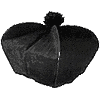
the Black Biretta is a pun on the Scarlet Pimpernel and the "Black Adder" of British sitcom fame. Here you will find me opining on things ecclesiastical, but with a slight dose of satire as well.

Thursday, October 06, 2005

Faithful priest answers dissident priest


Matt C. Abbott
Matt C. Abbott
October 6, 2005


In a September 9, 2005 column in The Tidings, the newspaper of the Archdiocese of Los Angeles, renegade priest-professor Richard McBrien took a cheap shot at Father John Trigilio, author and EWTN television personality.

McBrien sneered: "...Indeed, there is a book, Catholicism for Dummies, co-authored by two priests who also lack theological credentials. But they are 'safe' enough to have a regular program on Mother Angelica's Eternal Word Television Network (EWTN)...."

Trigilio, along with Father Kenneth Brighenti, is the author of Catholicism for Dummies.

Trigilio sent the following (slightly edited) e-mail to The Tidings in response to McBrien's column:

"Father Richard McBrien's ad hominem attack on me and my co-author, let alone the uncharitable and slanderous remarks against Mother Angelica and EWTN, are completely inappropriate for an archdiocesan newspaper. He launched a scud missile against Catholicism for Dummies, yet it alone has an official imprimatur, whereas the competing editions — The Complete Idiot's Guide to Understanding Catholicism and The Everything Catholicism Book — have none whatsoever.

"He brings up the issue of theological credentials. If he means we are not dissident theologians who repudiate the official Magisterium like some of the illustrious academicians of some allegedly Catholic colleges and universities, then by all means we are not in that infamous league.

"We used the Catechism of the Catholic Church as our foundation and schema for the book, so if orthodox catechesis bothers Father McBrien, he should stay away from our book.

"Instead of a character assassination on Senator Rick Santorum, McBrien should reread the Catechism, especially the apostolic letter of Pope John Paul the Great, 'Laetamur Magnopere,' thereby promulgating the Latin typical edition. There, it explicitly refers to the Catechism as the 'authoritative exposition of the one and perennial apostolic faith.' Perennial is the key word.

"The moral and doctrinal teachings of the Catholic Church are perennial; they do not change. Disciplines may adapt with time, but doctrine, since it centers on truth, must be immutable. Whether it is doctrine of the male priesthood or of the Real Presence, whether it is the immorality of abortion or contraception, these truths do not change. That is why we have one Catechism for the entire universal Church.

"We are confident that our Catholicism for Dummies is more in conformity to that Catechism than McBrien's book, Catholicism, which conspicuously lacks an imprimatur in the recent third edition."


Matt C. Abbott is a Catholic columnist with a Bachelor of Arts degree in Communication, Media and Theatre from Northeastern Illinois University in Chicago, and an Associate in Applied Science degree in Business Management from Triton College in River Grove, Ill. He is the former director of public affairs for the Chicago-based Pro-Life Action League and the former executive director of the Illinois Right to Life Committee. He was a contributor to The Wanderer Catholic newspaper and had numerous letters to the editor published in major newspapers, including the New York Times, USA Today, the Wall Street Journal, the Chicago Tribune, and the Chicago Sun-Times. He can be reached at

mattcabbott@gmail.com

Friday, April 29, 2005

Queen of Dissent

The notorious dissenter Sister Joan Chittister, OSB, made this obscene statement (April 20th, 2005) in the National Catholic Reporter:

"We’ve been living in an ecclesiastical tsunami this week. The election of Cardinal Joseph Ratzinger to the position of Pope Benedict XVI has had all the force of a universal avalanche."

She should be grateful that this was not the Middle Ages when the Holy Office of the Inquisition would have turned her over to civil authorities for trial on the charges of slander, sacrilege and apostasy. Instead, the Benedictine nun lives in the 21st century where enemies of orthodoxy, the Magisterium and the Roman Pontiff can openly attack the Vicar of Christ with impunity, vitriolic rhetoric and diabolical motivation since Satan wants nothing more than to divide and conquer; to destroy the unity of Holy Mother Church. Pope John Paul II was and now Pope Benedict XVI is the personal sign of unity in the church as chief pastor, teacher and shepherd. He possesses full, supreme, immediate and universal authority the moment he became pope and that has been consistently taught by Vatican II, Canon Law and the Catechism, if Sr. Joan ever bothered to read any of those official documents. UBI PETRUS IBI ECCLESIA said Saint Ambrose, so an attack on Pope Benedict XVI is an attack on the Catholic Church. As Prefect for the Sacred Congregation for the Doctrine of the Faith, then Cardinal Ratzinger staunchly defended the infallible teachings of our holy religion as taught by the Magisterium. Imagine a grammar school teacher instructing her students that there were only 20 letters of the alphabet instead of 26. Would parents tolerate such academic pluralism? Or a geography teacher telling his class the world is really flat. Truth is the conformity of the intellect (mind) to reality and not vice versa. Laws of grammar, physics, chemistry, mathematics, etc., are like divinely revealed truths: immutable. Water is H2O whether on earth or on Mars. The immorality of abortion and euthanasia is as perennial as the immorality of adultery and murder. No exceptions. The error of female ordination is as untrue as 2 + 2 = 5 but in Sr. Joan's universe, doctrinal and moral truths are changeable and that would make as much sense as a physician who thinks open heart surgery can be done with a local anesthetic or that cigarette smoking is non-lethal. If recalcitrant miscreants like Chittister don't like the truth, they can deny it but do so OUTSIDE the church. At least Martin Luther, John Calvin, Zwingli and Cramner had the decency to leave the Roman Catholic Church when they disavowed her doctrines and disciplines. Radical feminists who spew their heretical rantings can start their own church and religion and leave ours.

Thursday, April 21, 2005

Pope John Paul the Great
the Luminous Doctor


Following in the footsteps of Pope Saint Leo the Great and Pope Saint Gregory the Great, it is evident that history and Holy Mother Church herself will one day not only canonize our recently departed Pope John Paul II, but also impart the rare title of “the Great” as well as declaring him a Doctor of the Church. Before the Good Lord called the Servant of the Servants of God home at 9:37 pm on April 2nd (the vigil of Divine Mercy Sunday), Karol Jósef WojtyÅ‚a reigned as supreme Roman Pontiff for more than 26 years, made 104 international trips, beatified 1,338 and canonized 482 saints; authored 14 encyclicals, 15 apostolic exhortations, 11 apostolic constitutions, 45 apostolic letters, and five books.

Just as Saint Bonaventure is known as the Seraphic Doctor and Saint Thomas Aquinas as the Angelic Doctor, it stands to reason that John Paul II should be given the title Luminous Doctor or the Doctor of Light and Hope. The first words of his pontificate, “be not afraid” were mirrored by his prolific writings and speeches, his pastoral visits, his popular Word Youth Days, and his courageous battle with disease, illness, assassination attempt and old age. “Fear not” and “be not afraid” were spoken by the Archangel to Our Lady and to Saint Joseph prior to the birth of Jesus Christ who Himself uttered those sentiments to His disciples after the Resurrection when they thought they were seeing a ghost. Pope John Paul II dispelled the fear which crept into the church following the Second Vatican Council. Not that Vatican II caused the fear and doubt, but the powers of darkness successfully distorted and diluted the Council documents so as to promote the alleged ‘spirit of Vatican II’ rather than the ‘letter of Vatican II.’

Ultra-liberals called him an archconservative and ultra-conservatives thought he was not traditional enough, but John Paul II was not sympathetic to either classification of liberal or conservative, progressive or traditional. He was just orthodox. A true son of Vatican II, it was under his reign, at his command and with his guidance that the Church was given some invaluable and precious pearls which sadly some swine do not appreciate. He gave us the revised Code of Canon Law in 1983 which had not been updated since 1917. He gave us the Catechism of the Catholic Church in 1992 which was only preceded by the Catechism of the Council of Trent four centuries earlier. He gave us epic encyclicals like Redemptor Hominis, Mater Redemptoris, Ecclesia de Eucharistia, Laborem Exercens, Familiaris Consortio, and Ut Unum Sint but of all these, Evangelium Vitae, Fides et Ratio and Veritatis Splendor stand out as his greatest masterpieces and were the beacons of light which emanated the sublime truths of our Catholic religion. They alone warrant him the title Doctor of Light and Salvifici Doloris and his indefatigable courage to battle the Nazis, Communism, Secular Humanism, materialism, moral relativism, sexual permissiveness, et al., merit him the title Doctor of Hope.

I was in High School Seminary when he was elected Pontiff in 1978. The first two years were during the final years of the then ailing and aged Pope Paul VI. Vocations were declining, Mass attendance and confessions were dropping, dissident theology was proliferating Catholic colleges and seminaries, and other cancers were infecting the church for several years after Vatican II. Tabernacles were hidden, religious garb was discarded, catechisms were watered down, sacraments and sacred liturgies were irreverently innovated and the faithful were raped of sacred art, orthodoxy and solid leadership in many corners of the world until a man was sent from God named “John Paul II.” Since his election as Bishop of Rome and 264th Successor of Saint Peter, JP2 has encouraged many vocations, conversions, reversions, and initiated a true Catholic Renaissance.

Sure, liturgical and doctrinal abuses continued in the sanctuaries, colleges, seminaries and sadly even in some rectories (where children were abused) but there has never been a period of human history where there is no sin and no evil. These aberrations would have occurred regardless of who was Pope at the time since human free will is not limited to one time or place and men of the church, just as men of the world, can freely choose good or evil. It is unfair and unjust to blame Pope John Paul for the clergy sex abuse scandal when it was the fault of the perverted clergy who actually committed the abuse of children and teenagers and the bishops and seminary faculties which looked the other way when these deviants were under their authority and supervision. Lex ordandi, lex credendi, lex agendi. Bad liturgy and bad theology will feed and support one another and will inevitably lead to bad morality and behavior. Liturgical abuses, dissident theology and heterodox doctrine will spawn moral depravity and other evils. At the same time, reverent (valid and licit) liturgy combined with orthodox theology (based on the Magisterium) will also promote and sustain pious and holy lives, for clergy, religious and laity alike.

Pope John Paul II was neither perfect nor impeccable but he was infallible as Pope and exercised his supreme teaching authority in Ordinatio Sacerdotalis which closed the debate once and for all on women’s ordination. He was human and had his weaknesses like the rest of us but he had more courage, piety, devotion, patience, prudence, intelligence, wisdom, compassion and integrity than anyone else of the last century. He gave the Church a banquet of truth in his teachings, much like the Summa of Aquinas which is even today still producing good fruit. Sadly, modern man and modern Catholics are content with the bare minimum of spiritual life support rather than feasting on the fullness of grace, truth and tradition Holy Mother Church offers and which was offered in an exquisite presentation by Pope John Paul II. It would be like someone opting to have an intravenous solution drip in their arm when the alternative would be a seven course gourmet meal with every vitamin, mineral and necessary nutrient inside.

When he gave the Church the five new Luminous Mysteries to the Holy Rosary, it also symbolized the light of hope he brought to the Church during his 26 year pontificate. Our loss is heaven's gain.

Rev. John Trigilio, Jr., PhD, ThD
President, Confraternity of Catholic Clergy
www.catholic-clergy.org

Friday, August 29, 2003

Letter from CCC to USCCB President on Celibacy

Most Reverend Wilton D. Gregory
President, United States Conference of Catholic Bishops
3211 4th St. N.E.
Washington, D.C. 20017-1194

August 29, 2003

Your Excellency,

The Confraternity of Catholic Clergy denounces the petition of the 163 priests of the Archdiocese of Milwaukee seeking optional celibacy in the priesthood of the Latin Rite. We declare our unequivocal support for the ancient discipline of priestly celibacy in the Western Church. Furthermore, we do not believe that modifying or abandoning mandatory celibacy in the Western Church, normative since the Council of Elvira (306 AD) and obligatory since Pope Gregory VII (1074 AD), is the answer to the current problems facing the universal and local church.

Unlike the Byzantine Catholic and Eastern Orthodox Churches which have had a consistent tradition of optional celibacy, the Roman Church decided long ago to follow a different path. There is no evidence whatsoever, that ending mandatory celibacy would have prevented any acts of sexual misconduct, from pedophilia to ephebophilia. Studies show that the overwhelming majority of perpetrators of these heinous crimes are non-ordained, non-celibate family members.

The fact that some celibate clergy (bishops, priests and deacons) have sexually abused children and adolescents, however, warrants realistic remedies which conform to traditional discipline and defined doctrine. The Confraternity of Catholic Clergy, founded in 1975, is composed of over six hundred diocesan and religious priests and deacons from the United States and Canada, and is committed to the ongoing spiritual, theological, pastoral and fraternal formation of the clergy. Unlike some national associations of priests, the CCC has no desire to interfere with the authentic teaching authority of the Magisterium nor do we seek to usurp the legitimate jurisdiction of the national or local hierarchy.

Optional celibacy is not the answer, nor is it the panacea; it is a placebo. It will do nothing. The current crisis in the Catholic Church in America is three-fold. Bad theology, bad liturgy and bad morality have caused the damage and like a malignant tumor, needs to be excised. Heterodoxy as taught by dissident theologians in seminaries and Catholic colleges, supported by liturgical abuses and an iconoclastic crusade to remove reverence from public worship, will inevitably produce immoral behavior. Lex orandi, lex credendi, lex agendi.

We ask you and the entire Conference of Bishops to thoroughly, completely and systematically investigate and eliminate all vestiges of heterodoxy, homosexuality and liturgical abuse from all seminaries and to fully implement Ex Corde Ecclesiae in every Catholic college. We ask you and all the bishops as our chief shepherds to inaugurate a Catholic renaissance of reverent celebrations of the Sacraments, especially the Holy Mass, respecting the valid options allowed by the universal church; of conforming all teachers and their teachings to the Magisterium; and of fostering solid, manly vocations, obedient sons of the Church who will live chaste and prayerful lives. Only by restoring the sacred, by defending the revealed truths and by upholding the natural moral law can we achieve any victory over the current crisis of faith now affecting the Church.

You can count on our prayers and support in these endeavors. May Christ the High Priest and His Holy Apostles watch over, guide and direct all the deliberations and discussions held by the American Bishops.

Respectfully Yours,

Rev. John Trigilio, Jr., PhD, ThD
President

Thursday, November 28, 2002

Goodbye! Good Catholics

Michael Rose's controversial (but accurate) book, Goodbye! Good Men, concerns the up-to-now secret crisis in American seminaries which has lasted for a quarter of a century. Most on the left and a few on the right have attacked, repudiated, chastised, ignored, vilified, or denounced the author or at least have attempted to challenge and/or discredit the data and testimonies contained in the book. Many liberals and some conservatives have jumped on the bandwagon to condemn the author, criticize the scholarship, and rebuke the narratives.

Despite these efforts, those of us who actually survived the seminary experience know too well how true those tales really are. The problem is that no book can address all the issues and propose all the solutions. The horror stories Rose relates brings back many painful memories, but also sheds light on dark secrets which until now have been kept locked up in the basement. Like the pedophilia scandal, the seminary scandal was swept under the carpet for too long. Sadly, without the pressure of the media and the threat of impending lawsuits, this demon may not get the speedy and serious response as was given in Dallas by the Episcopal conference. Even though the Holy See has ordered a thorough investigation of all seminaries and their formation programs, whether or not it disintegrates into an impotent "visitation" like the last one may be an easy bet.

Were a sequel or volume two to come out, it could concern the improvements made by some of the previously bad seminaries and include more on the current good ones. The first book told stories from 10 to 20 to almost 30 years ago, and many of those places are now closed, the faculty members are deceased or have left the priesthood, or some seminaries have been pretty well cleaned up by subsequent rectors and bishops.

Even during the "dark ages" when dissident theology, liturgical abuse, and sexual immorality flourished at an all-time high, there were always in every seminary and diocese some champions of orthodoxy and decency who, although the minority, gave those of us who were in the trenches the courage to keep going and never quit. The good, orthodox, and holy priests (albeit a few), be they diocesan, Vincentian, Divine Word, or otherwise, who sustained us in some of the bad seminaries, or who now run the improved places, should never be forgotten or abandoned.

The most distressing aspect of this affair is that many good bishops, priests, and laity refuse to believe the magnitude of the problem. As Jack Nicholson said in the movie A Few Good Men, "You can't handle the truth." Goodbye! Good Men only scratched the surface, so a second installment could equally reveal more of the cancer infecting the Church. There were other seminaries not mentioned in the book and many tales not told. While it is true that the situation has improved in general across the nation and that the 1970s and 1980s were the absolute nadir of seminary life, nonetheless, theological dissent, liturgical abuse, and elements of homosexuality still permeate many places, though at a more subdued, discreet, and covert manner.

The lawsuits of today mostly concern crimes of the past, yet sins of the present are still being done and left untouched. The premise in Goodbye! Good Men is that many good men were sacrificed to the wolves so as to promote mediocre and in some cases bad men in their place. Good men who were manly, orthodox, pious, and obedient would often be targets while androgynous, heterodox, flamboyant, and very liberal "men" sailed through the seminary with flying colors. As long as the student accepted and embraced the theological lies being told and as long as he supported liturgical innovations and had a distaste for traditional and reverent ritual, then he would get sterling evaluations from faculty and peers alike.

This did not happen in every seminary nor all the time, but in enough of them and often enough to cause great harm to Holy Mother Church. Like Soviet sleeper spies or moles who would infiltrate the United States, dissidents from magisterial teachings on doctrine, liturgy, and morals tried to plant agents among the various dioceses, parishes, and religious communities to bring about the "revolution." This one, unlike the Russian Revolution of 1917, is barely political, but is predominantly theological, liturgical, and social. Proponents of married clergy, women priests, homosexual marriages and homosexual clergy, pedestrian worship, nontraditional ceremonies, erosion of the sacred and glorification of the banal, and independence from Rome are as much around in 2002 as they were 10, 20, or 30 years ago.

There is a second danger that since many good men who probably had a genuine priestly vocation were nevertheless turned away, thrown out, or converted to the "dark side," then another target will be many good Catholic faithful. Goodbye! Good Catholics might be the next book to hit the market.

Ironically, some at the U.S. Conference of Catholic Bishops (USCCB) spend much time and effort trying to restrict and contain EWTN through complicated canonical regulations, while dissident theologians are not even remotely intimidated by the mandatum required by Ex Corde Ecclesiae. A bishop may or may not revoke or grant a mandatum to a particular theologian and he or she may or may not possess one, yet there is no mechanism to demand that only theologians with a mandatum can and ought to teach in Catholic colleges and universities. Having or not having the mandatum has little if any consequences for theologians, whereas getting the proper permissions from bishops and superiors just to broadcast a radio or television program is much more intrusive, manipulative, and will be done with more severity, you can be sure.

Teach heterodoxy at a Catholic college and you may or may not get your mandatum revoked, but you will still have your job, even though parents and students are paying obscene amounts of tuition for an allegedly Catholic and orthodox education. On the other hand, if you are on TV or radio and explain the unadulterated authentic faith as taught by the Magisterium, you still need permission slips from one to three bishops.

Good Catholics are being intimidated and discouraged when nothing or very little is ever said or written by the bishops concerning Catholics who do not regularly attend Mass, who live together before marriage, who use contraception, who openly support abortion and/or political candidates who also deny the right to life of the unborn. Politicians who are pro-abortion are never excommunicated, yet priests who validly and licitly celebrate Mass ad orientem are threatened with suspension. Cohabiting couples are allowed to have elaborate weddings with white gowns et al., while traditional Catholics who legitimately ask for the indult (Ecclesia Dei) Tridentine Mass are either refused or only given a token permission for one day a month on a Saturday evening.

Documents on global warming, nuclear weapons, economics, and so-called church art are prolific. Issues like waning belief in and reverence for the Real Presence, the abuse of general absolution, sporadic Mass attendance, gross ignorance of the faith among the post-confirmed faithful, rejection of papal and magisterial authority are never addressed.

Good Catholics who devoutly come to church every week, if not every day, and who reverently kneel before their Lord and God are now being bullied and insulted and harassed for not standing instead. Bad enough that the bishops approved of an emendation to the rubrics of the Institutio Generalis Missalis Romani (IGMR) n. 160 which, as approved by Rome, will make standing the normative posture for receiving Holy Communion. Kneeling or genuflecting will be discouraged, but those who do so cannot be denied Communion.

Instead of beating up the few faithful who devoutly kneel, especially at a Communion rail, or who momentarily genuflect, why not spend the effort and energy going after the faithful who show no reverence whatsoever? Communicants with dirty hands, sometimes with tattoos or pen writing all over them; those who refuse to observe the one hour fast before Communion; non-Catholics and persons invalidly married coming to Communion; and those who truly do not believe that the bread and wine have substantially changed into the Body and Blood, Soul and Divinity of Christ — these are the people the bishops need to correct, not the pious and reverent who give proper adoration to the Real Presence.

There are even parishes and dioceses which blatantly violate rubric n. 21 of the General Instruction of the Roman Missal (also n. 43 in the IGMR) which mandates the posture of kneeling for the consecration and in the United States, for the entire eucharistic prayer. Yet, nothing is done to enforce that law. Jorge Cardinal Medina Estevez has clarified that each priest may celebrate Mass versus apsidem and not only and just versus populum, but see what happens if the local parish priest faces the tabernacle instead of the people.

The cover-up over transferred pedophiles eroded much confidence the laity had in general for the American hierarchy. The sex scandals themselves diluted a lot of respect and admiration for the priesthood. The only constant our people have is the true faith. Leaders, being human, will inevitably sin and make mistakes, but the divinely revealed faith is perennial, constant, and unchanging. Seven sacraments and the Deposit of Faith keep us all, clergy and laity, grounded in the one true Church.

Bad examples have always been with us. Even the first bishops were less than exemplary: Peter denied Christ, Thomas doubted, Judas betrayed Him, and 11 abandoned Him as He died on the cross. Yet, the Catholic Church survived. She endured the Eastern Orthodox Schism of 1054, the Avignon Papacy, the Western Schism and Three Popes, the Protestant Reformation, and so on. She will endure our current crisis as well. Those of us living in these times, however, cannot be inactive bystanders, either.

Pray for our bishops, show them respect, and obey all their lawful and licit commands. We are not Protestants who make themselves their own pope, and so, we must follow the chain of command but know what we are obliged to do and what we are encouraged to do. The Holy See (the Pope and the Vatican) and universal law outrank lower authorities. Hence, no priest or pastor can countermand or revoke a lawful order or decree of the local bishop any more than the local bishop can circumvent or ignore the legitimate authority of Rome.

If Rome says something is permitted, it is permitted all over the world unless Rome has specifically allowed local bishops to say otherwise (very rare). If the local bishop makes a lawful policy for the diocese, no individual pastor or priest has the authority to change it. If the diocese says no weddings on Sundays, then no priest can ignore that. If Rome says we kneel at the consecration, then no bishop or conference of bishops can say otherwise.

Before more good men with genuine vocations to the priesthood and diaconate are prevented or discouraged from being ordained and before more good Catholics are disgusted and discouraged as well and perhaps even stop going to church, why don't our shepherds fully commit themselves to an aggressive and thorough investigation and reform of our seminary system; to a comprehensive removal of all theological dissenters, liturgical abusers, and homosexual clergy and faculty, in all Catholic colleges, universities, and seminaries; to a renewal and renaissance of reverence and reaffirmation in the belief of the Real Presence by showing more respect for the Blessed Sacrament, i.e., moving the tabernacles back to the middle of the sanctuary (n. 314 "a noble, worth and conspicuous" location), allowing the option of receiving Holy Communion standing or kneeling (just as they currently have the option of in the hand or on the tongue), and enforcing the rule on kneeling for the consecration (and in the United States for the entire eucharistic prayer)?

Bad theology is supported by bad liturgy and both promote bad morality. Orthodox theology is supported by reverent liturgy and both promote holiness as well as good morality. Sound doctrine and reverent worship of the Real Presence always produce abundant vocations. Check the dioceses where many vocations flourish and examine the parishes those men come from. Places where the Blessed Sacrament is prominent and highly respected and where the authentic teachings of the Church as defined by the Magisterium are defended and promoted — these are the fertile grounds for priestly and religious vocations.

It is no secret that colleges like Christendom, Thomas Aquinas, Franciscan University in Steubenville, and now Ave Maria are doing well since parents and students are assured of a high-caliber, authentically Catholic education and environment. Dioceses and bishops who are known for their orthodoxy and send candidates to solid seminaries which have reverent Masses, frequent if not perpetual adoration of the Holy Eucharist and thoroughly Catholic catechesis from children to adults, will provide the vocations for these dioceses as well as students for these colleges.

There is an old saying that it is superfluous to preach to the choir. It is also dangerous to beat up the choir as well. Instead of harassing devout Catholics for showing sincere eucharistic piety and rather than persecuting orthodox seminarians and instead of attacking priests loyal to the Roman Pontiff and Magisterium, why don't the successors of the Apostles correct the real offenders and culprits?

Dissent from doctrine is no different than dissent form the moral law. Dissidents who teach erroneous theology are on the same plane as perverts who prey on children. The former corrupts the innocence of the mind and the latter contaminates the innocence of the body. Zero tolerance for pedophile priests should include zero tolerance for heterodoxy as well as zero tolerance for sacrilege — which occurs whenever liturgical abuse and aberrations are consciously performed.

My Blog List

Blog Archive