
Tuesday, January 11, 2011

Two Catholics Among Several Victims at Tuscon Massacre


As our prayers go out to Representative Gabrielle Giffords for her recovery from the the heinous and brutal shooting in Tuscon last week, we also remember the victim bystanders who died from their wounds inflicted upon them by the diabolical Jared Lee Loughner. Christina Taylor Green (age 9) and US District Court Judge John Roll were senselessly slain by the psychotic madman. Both victims were members of the Catholic faith and regularly attended their local parishes. Christina had recently made her First Holy Communion.

---------------------------------------------------------------------------------  


As Tucson mourns, victims are remembered


By Catholic News Service

TUCSON, Ariz. (CNS) -- With flags nationwide flying at half-staff and people pausing for a moment of silence Jan. 10, the victims of the Jan. 8 mass shooting in Tucson were being remembered for their warmth and goodness, some for their sense of public service, and several for their involvement in their churches.

The attack during a Saturday morning meet-your-congressional-representative event at a Safeway shopping center left six people dead and another 14 wounded, including Rep. Gabrielle Giffords, 40, who hosted the event. The alleged shooter, Jared Lee Loughner, 22, was stopped by bystanders and is being held on initial federal charges related to the deaths of two U.S. government employees -- a federal judge and a congressional aide -- and the attempted murder of Giffords and two of her staff members.

Amid the outpouring of grief and shock in Arizona, the personal stories of the shooting victims were putting their faces into focus for the world.

U.S. District Court Judge John M. Roll, 63, and Christina Taylor Green, 9, who were killed, were both active in their Catholic parishes. Roll, the chief judge of the Tucson federal court, had stopped by the shopping center in northwest Tucson to see Giffords on his way home from morning Mass at St. Thomas the Apostle Church. Bill Badger, one of several people who tackled the shooter to stop his rampage, despite his own gunshot wound, also is active in the parish he shared with the judge, according to Fred Allison, spokesman for the Tucson Diocese.

Young Christina Green came to meet Giffords with a neighbor because she was so interested in civics, having just been elected to the student council at Mesa Verde Elementary School. The third-grader also was part of a children's choir at St. Odilia's, the Catholic church a few blocks from the shooting scene where a healing and remembrance Mass was scheduled for Jan. 11.

The young athlete was part of a sports-focused family. Her grandfather is former major league pitcher and manager Dallas Green, and her father, John Green, is a scout for the Los Angeles Dodgers. The only girl on her Little League team, Christina was born on Sept. 11, 2001, and was featured in a book called "Faces of Hope," about 50 babies born on that day of terrorist attacks on the United States.

Roll, a fourth-degree member of the Knights of Columbus, was remembered as "a person of great faith and great integrity" who was a devoted member of two Tucson Catholic parishes, according to Bishop Gerald F. Kicanas. Bishop Kicanas returned to Tucson hastily from the Middle East, where he was to attend the annual Coordination of Episcopal Conferences for the Church in the Holy Land, representing the U.S. Conference of Catholic Bishops.

The bishop was to preside over a Mass for the Healing of Our Community, Remembrance of Those Who Have Died, and for the Consolation of All Victims and Their Families at St. Odilia's, where Christina Green made her first Communion last spring.

"'Let the children come to me,' Jesus said (Mt 19:14). Christina is with him," wrote Bishop Kicanas to parishes.

Roll for many years began his day by serving at Mass as a lector at Sts. Peter and Paul Parish or St. Thomas the Apostle Church, the bishop said. "He lived his faith as a servant of our nation for the cause of justice."

Allison said he regularly saw Roll at the daily noon Mass at St. Augustine Cathedral, a few blocks from the federal courthouse downtown.

"He was absolutely dedicated and devoted in terms of daily Mass attendance and dedicated to the ministry as a lector," Allison said. "His faith was a wellspring of who he was as a judge and in his marriage.

The bishop put words to the emotions felt by people in Tucson and around the world who watched events unfold at the suburban shopping center.

"It is incomprehensible that such a horrible tragedy could happen in the community that we love so much," he wrote in his letter. "I am shocked and devastated as I see the horrible pictures on the news and hear the reports of those who have been killed and injured."

In a message, Bishop Kicanas sent to Allison as he left Jerusalem to return to Tucson, he said watching the television coverage from afar was overwhelming. "I could not sleep. I just wanted to return home as soon as possible."

He noted that "as I would expect, the community has risen to the occasion," with bystanders stepping up to help at the scene, medical personnel working feverishly, and public servants "trying to find answers to a horrific act of violence perpetrated against innocent people, everyone praying and offering support and condolences."

He said that before he left the Middle East, he concelebrated a Mass with 10 other bishops in a small Catholic church in Jericho, where only about 50 Catholic families are in the village, "but they all expressed to me their condolences for what happened in Tucson and promised their prayers as did each of the bishops from Canada, Albania, France, Germany, England and the Holy Land. Their comfort and heartfelt prayers meant a lot."

Bishop Kicanas went on to observe that "in the Holy Land, violence is feared and expected. Violence, too often, tears apart both the Israeli and the Palestinian people. Each community knows well the result of senseless violence. Their families have mourned the loss of loved ones and cared for those injured.

He added that the people in Jericho, hearing about the Tucson events, asked him how to prevent such acts of violence.

"I wish I knew the answer," he wrote. "But as the world continues to seek an answer to that question we can, each in our own way, strive to respect others, speak with civility, try to understand one another and to find healthy ways to resolve our conflicts.

"But right now it is important as a community to pull together and to reach out in care and concern to all who have been affected by this tragedy," he added.

Read more: http://www.catholiccourier.com/news/world-nation/as-tucson-mourns-victims-are-remembered/#ixzz1AjmiLHlU


Saturday, January 01, 2011

Buon Natale


Merry Christmas and Happy New Year from Our Lady of Good Counsel, Marysville, PA


Monday, December 20, 2010

Church must repent, repair damage caused by clerical abuse, pope says

By Carol Glatz
Catholic News Service

VATICAN CITY (CNS) -- In response to the "unimaginable" scandal of clerical sex abuse against minors, the church must reflect, repent, and do everything possible to rectify the injustices suffered by victims as it works to prevent such abuse from ever happening again, said Pope Benedict XVI.

The pope said he and others were "dismayed" when, during a year dedicated to the world's priests, further cases of clerical sex abuse came to light "to a degree we could not have imagined."

"We must accept this humiliation as an exhortation to truth and a call to renewal. Only the truth saves," the pope said Dec. 20 in his annual pre-Christmas address to the Roman Curia and cardinals who reside in Rome.

In his seven-page reflection on the past year, the pope dedicated a large part of his speech to the impact of sex abuse by priests.

He said priests who committed such scandals "twist" the sacrament of ordination into its "antithesis" when they, "under the mantle of the sacred, profoundly wound human persons in their childhood, damaging them for a whole lifetime."

The face of the church is soiled and her clothes torn "because of the sins of priests," the pope said, referring to the writings of the 12th-century German mystic, St. Hildegard of Bingen, who had visions of a church wounded and sullied because of abuses by clergy evident in her day.

"We are well aware of the particular gravity of this sin committed by priests and of our corresponding responsibility," the pope said.

He listed a number of "musts" that the church needs to attend to.

"We must ask ourselves what we can do to repair as much as possible the injustice that has occurred. We must ask ourselves what was wrong in our proclamation, in our whole way of living the Christian life, to allow such a thing to happen," the pope said.

The church must find "a new resoluteness in faith and doing good," it must be capable of penance, and it must strive to do everything possible in preparing future priests "to prevent anything of the kind from happening again," he said.

Amid the "great tribulations" the church has faced during the last year, he said, the Advent prayer, "Stir up your power, O Lord, and come that you may save us," often has been "on my mind and on my lips."

Rather than beg Christ to wake up and deliver his disciples from a storm, it is the disciples themselves who must reawaken their own faith that has "grown tired," the pope said.

He said what needs to be restored is a faith that has "the power to move mountains, that is, to order justly the affairs of the world."

As the church works to address the sex abuse crisis within its own walls, it must also tackle the larger problems of child pornography and child sex tourism in society, the pope said.

"The psychological destruction of children, in which human persons are reduced to articles of merchandise, is a terrifying sign of the times," he said, as he lamented how child pornography is considered "more and more normal by society."

Insatiable desire and "the excess of deceiving intoxication becomes a violence that tears whole regions apart, and all this in the name of a fatal misunderstanding of freedom which actually undermines human freedom and ultimately destroys it," he said.

The pope called on pastoral leaders to renew "the great rational tradition of Christian ethos" and to replace the modern day notion of relative or pragmatic morality with "the essential and permanent foundations of moral actions."

In his address, the pope also spoke about the Synod of Bishops for the Middle East in October and lamented that "Christians are the most oppressed and tormented minority" in the region.

"The tradition of peaceful coexistence has been shattered and tensions and divisions have grown" in many parts of the region, he said.

He expressed his gratitude for "voices of reason" such as Muslim leaders who speak up against violence against Christians. However, those voices "are too weak," he said, and Christians are "up against an unholy alliance between greed for profit and ideological blindness."

The pope urged all political and religious leaders to put an end to "Christianophobia" and to defend refugees and those who suffer as well as revitalize the spirit of dialogue and reconciliation.

Finally, the pope offered a reflection on his trip in September to the United Kingdom and the beatification of Cardinal John Henry Newman.

Blessed Newman's spiritual conversion is an important model of "a path of obedience to the truth" that gradually opens up to a person, the pope said. It is a path of conscience, which is the human capacity to recognize the truth, and therefore seek it out and freely submit to it, he said.

Underlining the human capacity for objective truth is imperative in a world that is "troubled by the sense that moral consensus is collapsing, consensus without which juridical and political structures cannot function," he said.

The pope took note of French political philosopher Alexis de Tocqueville's observations of 19th-century America and how democracy there "had become possible and had worked because there existed a fundamental moral consensus, which transcending individual denominations, united everyone."

Before the pope's address, Cardinal Angelo Sodano, dean of the College of Cardinals, told the pope that the cardinals had begun a collection during the November consistory to aid the poor and sick in Haiti and Iraq.

Two sums of $100,000 each were being sent to Haiti and Iraq via the church's apostolic nuncios and would be distributed to Catholic organizations on the ground.

END


While we have been greatly blessed with the pontificates of two saintly popes (JP2 & B16) who have given the Church magnificent leadership, the Evil One has had numerous successes in his battle for souls. The clergy sex abuse of children continues to have a malignant effect on the Mystical Body of Christ. Unfortunately, many in the USA have fooled themselves into thinking that the Dallas Charter was the panacea that cured all these ills.  Running background checks with the state police and getting fingerprints from the FBI only provide one level of defense. It does protect you from sexual deviants PREVIOUSLY caught who have a prior record. It does NOT protect you from pedophiles who were never caught and have no prior rap sheet. Likewise, it will not protect you from perverts who have not YET given in to their unnatural urges.  All the Dallas Charter does it protect you from the few who committed crimes in the PAST. That is only partial security, at best.

The pathological behavior and condition of pedophilia and ephebophilia are symptomatic of a much larger, prolific and diabolical strategy to attack the Church.

One, we NEED good shepherds to pastor the fold. The business model has failed us tremendously. Those bishops who followed the corporate schema are the ones who denied these heinous things happen and merely swept them under the rug.  Like executives at Enron, they responded by silencing the messenger, punishing the whistle-blower and transferring the malefactors. When bishops are seen or worse yet, see themselves, as middle management rather than as spiritual shepherds, they are governed by legal assistants and bean counters who crunch numbers instead of defending doctrine. The business model is not right for the Church. Expediency and seeking the lowest common denominator do more harm to an ecclesiastical organism.  Political solutions are even more detrimental. We NEED PASTORAL bishops, not business ones.

Two,we need to address the ENTIRE PROBLEM:  BAD THEOLOGY (dissident) + BAD LITURGY = BAD MORALITY 

in other words, besides responding swiftly and vigorously on all actual incidents of sexual misconduct, we need to simultaneously ensure that REVERENT, licit and valid sacraments are celebrated AND that sound doctrine in accord with the Magisterium is taught in all Catholic schools, seminaries and colleges. LEX ORANDI, LEX CREDENDI, LEX VIVENDI

Therefore, it is imperative that our bishops NOT be managers, bureaucrats or politicians, rather that they be true SHEPHERDS who are loyal to the Magisterium and defend orthodox doctrine; who love the Sacred Liturgy and Divine Worship and insist they be done correctly and reverently; who are not afraid to discipline when necessary for the common good of Holy Mother Church.  Problem is that in many cases, good shepherds often inherit bad or mediocre advisers. Often these middle management act like old Soviet style bureaucrats who exist merely to retain their position and the status quo. Pray for your bishop and his staff this Christmas as well as your local pastor, vicar and deacon.
Remember, too, to thank the Lord if your diocese sends its vocations to good seminaries (Mount St. Mary's, Emmitsburg; St. Joseph's, Dunwoodie, NY;  St. Charles Borromeo, Overbrook, PA; et al.)

                                                                                                                                                                                                                                                             ;                                                                                                                                                            ...................................................................................................................................................................................................................................................................................................................................................................................... 


Saturday, December 11, 2010

Bambinelli Blessing

                                                                                                        
Pope B16 blesses the bambinelli (infant Jesus) that the children of Rome brought from home


God our Father,
you loved us so much
you sent us your only Son, Jesus,
born of the Virgin Mary,
to save us and lead us back to you.

We pray that, with your blessing,
these images of Jesus might be
a sign of your presence and love
in our homes.

Good Father,
give your blessing
to all who gather with us this Christmas,
family and friends.

Open our hearts,
that we might receive Jesus in joy,
do always what he asks of us
and see him in those who need our love.

We ask this in the name of Jesus,
your beloved Son, who came to give peace to the world.
You who live and reign forever and ever.

Amen

Monday, December 06, 2010

Saint Nicholaus' Day December 6th


Santa began as a fourth century Catholic bishop named Saint Nicholas. The cult of St. Nicholas was one of histories most widespread religious movements. There are 2,137 churches dedicated to Nicholas in France, Germany, and the Low Countries alone before the year 1500." (Jones, Charles. W. "Knickerbocker Santa Claus." The New-York Historical Society Quarterly, October 1954, Volume XXXVIII Number Four, p.357)

The popular book, The Christmas Almanack, states, "By the height of the Middle Ages, St. Nicholas was probably invoked in prayer more than any other figure except the Virgin Mary and Christ Himself" (Del Re, Gerard and Patricia. The Christmas Almanack. New York: Random House, 2004, p. 131)

Miraculous folklore and legend surround the mysterious St. Nicholas. Among the more popular legends of St. Nicholas is the rescue of three poverty-stricken girls destined for prostitution. These girls were poor and did not have the dowry for marriage. St. Nicholas saved them from a life of shame, by providing marriage dowries of gold. They then were able to get properly married.

Another amazing miracle in the life of St. Nicholas is the three young boys who were sadistically murdered by a wicked innkeeper. Their bodies were chopped up and preserved in pickle barrels, with the cannibalistic intent of feeding their flesh to unsuspecting house guests. Of course, the amazing St. Nicholas resurrected the boys and their mutilated bodies. And like Santa, Saint Nicholas gave gifts to poor children, hence, his veneration as Patron Saint of Children. During the Middle Ages, hundreds of plays and paintings told and re-told the amazing feats of St. Nicholas.

Next, according to legend, Santa magically appears in the Netherlands around the seventeenth century. During this time, Sinter Klaas (a.k.a. Santa Claus) was officially born. Dutch children began the tradition of placing their shoes by the fireplace on December 5, for the mystic fourth century Bishop, Saint Nicholas. (Note: In the Dutch language Saint Nicholas is "Sint Nikolass," which was shortened to "Sinter Klaas," of which the anglicized form is "Santa Claus.") The next morning, the gleeful Dutch children quickly awoke to gifts and goodies in their shoes, left by Sinter Klaas. Like today’s Santa, Sinter Klaas, miraculously, traveled from housetop to housetop, and entered through the chimney.
Our next stop on the Santa highway is the year 1626 in the New World called America. Searching for the "American dream," Dutch settlers sailed from the Netherlands and established the Dutch colony called New Amsterdam (today called New York). The Dutch colonists quickly settled into America, bringing their customs, and of course, their beloved Sinter Klaas.

In December 1809, American essayist Washington Irving published a popular satire of the Dutch founding of New York titled A Knickerbocker History of New York. More than any other event, it was Irving’s Knickerbocker History that is credited for creating our modern day Santa Claus. The following history-making words from The Knickerbocker History became the public inauguration of Santa Claus. Who could have possibly imagined the significance these simple words would soon have?

And the sage Oloffe dreamed a dream,–and lo, the good St. Nicholas came riding over the tops of the trees, in that self-same wagon wherein he brings his yearly presents to the children. . . And when St. Nicholas had smoked his pipe, he twisted it in his hatband, and laying his finger beside his nose, gave the astonished Van Kortlandt a very significant look; then, mounting his wagon, he returned over the treetops and disappeared. (Irving, Washington. Knickerbocker’s History of New York, New York: Frederick Ungar Publishing Co., 1928, p. 50)

At this early period was instituted that pious ceremony, still religiously observed in all our ancient families of the right breed, of hanging up a stocking in the chimney on St. Nicholas Eve; which stocking is always found in the morning miraculously filled; for the good St. Nicholas has ever been a great giver of gifts, particularly to children. (Irving, Washington. Knickerbocker’s History of New York, New York: Frederick Ungar Publishing Co., 1928, p. 68)

Next stop on our investigative journey for Santa, surprisingly, comes from the pen of a New York theology professor named Dr. Clement Clarke Moore. In 1822, inspired by Irving’s popular, Knickerbocker History’s portrayal of jolly St. Nicholas, Dr. Moore quietly wrote a trivial poem titled, "A Visit from St. Nicholas" for his own children as a simple Christmas present. Dr. Moore had no intention of publishing his poem, but in 1823 it was published anonymously, by a friend, in the Troy Sentinel. Moore’s extremely popular poem was the spark that lit the Santa Claus wildfire. Santa quickly began flying through America. Dr. Moore’s poem was later renamed the famous, "Twas’ The Night Before Christmas."

The finishing touches for Santa occurred around 1863 from the artistic hands of cartoonist Thomas Nast. Inspired by Moore’s popular poem, Nast illustrated scores of Santa pictures in Harper’s Weekly and the world was officially baptized with the face of Santa Claus. Nast’s early Santa was burly, stern, gnome-like, and covered with drab fur, much unlike today’s colorful and jolly fellow. But make no mistake – it was Santa.

My Confirmation name was Nicholas. I chose it because of his love for children. Although I will never have my own, as a Priest, I want to appreciate every child I baptize and every boy and girl I minister to in my parishes. I have no nieces or nephews, but I do have several God-children that are as dear to me as if they were blood relatives.

I left my shoe out last night to see if St. Nick would leave  anything.  I found a stuffed cat toy, which I suspect Tiberius placed there instead ;-)

Friday, November 26, 2010

Pope Benedict and Condoms, NOT

 Pope Benedict XVI did NOT approve the use of prophylactics by homosexuals, heterosexuals or transsexuals to prevent the spread of HIV. The secular media took his words OUT OF CONTEXT and whenever you TAKE A TEXT OUT OF CONTEXT YOU GET A PRETEXT.

Pope OK's Condoms appeared on one cable network while another said Vatican Allows Everyone to Use Condoms to Pontiff Says Certain Circumstances Warrant Condom Use 
 All of these are FALSE. Consider this:
all acts of rape are gravely evil, immoral and sinful  
 
that is true and no one would debate it, would they? How about this statement?
intentionally infecting someone with a disease is also evil, immoral sinful  
 Now, if someone were to say  better a rapist to wear a condom and not infect his victim with a venereal disease does that DE FACTO translate into the person saying  condom use makes rape acceptable ?   
 
Of course not.
That a rapist who previously never used condoms but knew he had AIDS
now all of a sudden begins to use condoms to prevent infecting his
victims is still committing heinous evil (rape) but he is showing a sign
of moral improvement insofar as he does not want to infect an innocent
victim with a deadly disease. But it is not construed as a green light
for rapists to attack women just so long as they use condoms.
 Similarly,
the Pope was NOT approving condom use. He was saying it can be a sign
of moral improvement that someone engaged in immoral sexual intercourse
is at least trying to prevent infecting a person with a deadly disease.
The lesser of two evils is still evil. Rape is always wrong. All sex
outside of marriage be it between an unmarried man and unmarried woman
or between two men or two women. Yet, if someone has a VD, not only
should they do everything to prevent spreading the disease, they should
also ABSTAIN FROM ALL SEXUAL ACTIVITY. Rapists have no right to rape.
Sex is not a right but a privilege of marriage which is a covenant
between one man and one woman. Married sex must be oriented to love
(unity) and life (procreation) otherwise it is sinful behavior.
Contraceptive sex is immoral just as in vitro fertilization. 
If
a bank robber handed out bullet proof vests to the customers and
employees at the bank would that make his act of robbery acceptable? Of
course not. Handing out condoms to prostitutes may prevent venereal
disease but it also promotes immoral activity since the removal of the
threat of physical harm can tempt many to give in to temptation. No
immediate consequences to actions leads some people to fool themselves
that evil actions can sometimes be tolerated.
Why
not give condoms to teenagers in high school? Most are having sex
anyway?  Could condom use lure some who would normally abstain now try
"protective sex"?  How about just saying NO? As draconian as it sounds,
human beings are able and have been able to abstain from sex until
marriage for millennia.
 
THE ENDS NEVER JUSTIFIES THE MEANS
and the MEANS NEVER JUSTIFIES THE END
 ALL
Sex outside marriage is sinful and immoral. Contraceptive sex is
immoral. Premarital and extramarital sex is immoral, whether
heterosexual or homosexual.  Spreading venereal disease is immoral.
Having children outside of marriage is immoral.  Abortion is a grave
evil.  Obviously, giving birth as an unwed mother is far better than
killing the innocent life of the unborn via abortion. Nevertheless, the
BETTER scenario is for unmarried people NOT to have any sex and for
married people to practice Natural Family Planning rather than use
contraceptives.
The Church condemns suicide.  She also
condemns terrorism.  If a terrorist chooses to kill himself rather than
kill innocent victims, it is a lesser evil and he is showing some moral
movement in the right direction, but no one can construe that as a
blanket endorsement of suicide. Better if the terrorist kill NO ONE,
neither innocent victims nor himself. Better he repent and reform from
his evil ways ALL THE WAY.
 
Pope
Benedict was merely making a moral statement that someone already
involved in evil and sinful activity shows signs of moral improvement
when they choose the lesser of two evils. 
HOWEVER, any and all evil should be avoided. 
Why
not give clean needles to college students so they will not get
infections from tripping on heroin? How about not doing drugs at all? 
Why not have wives give their husbands a condom whenever he goes out of
town for a business trip? Is it not better he not impregnate someone he
is not married to OR that he not bring home a VD? How about he remain
chaste in marriage at all times?
Imagine
a parent discovered their child is the local bully. He beats younger
children up. What is the proper behavior to be sought? Is it not that
Junior STOP his belligerent and violent actions?  Or would it be
acceptable if the parents got their son to move from physical violence
to mere verbal and emotional violence?  When compared, there is the
lesser of evils, but there is also the reality that all abuse is evil
and UNACCEPTABLE. Some is worse than others but we cannot tolerate ANY
abuse. A sliding scale is not good enough. 
However, if you are the counselor advising the parents, you can say to them that a movement away from physical violence to only verbal abuse is an improvement BUT IT CANNOT STOP THERE.  Likewise,
use of condoms compared to indiscriminate and prolific sex is less evil
than unrestricted promiscuity but it is not good enough to stop at that
level. The final goal must be what is GOOD and not what is just less
evil.
The Pope did NOT promote condom use. He made
a comment on an evil situation which could be less evil in one way but
ultimately the BEST way is to avoid all immoral and evil acts
COMPLETELY.  

Thursday, October 21, 2010

Scarlet Fever

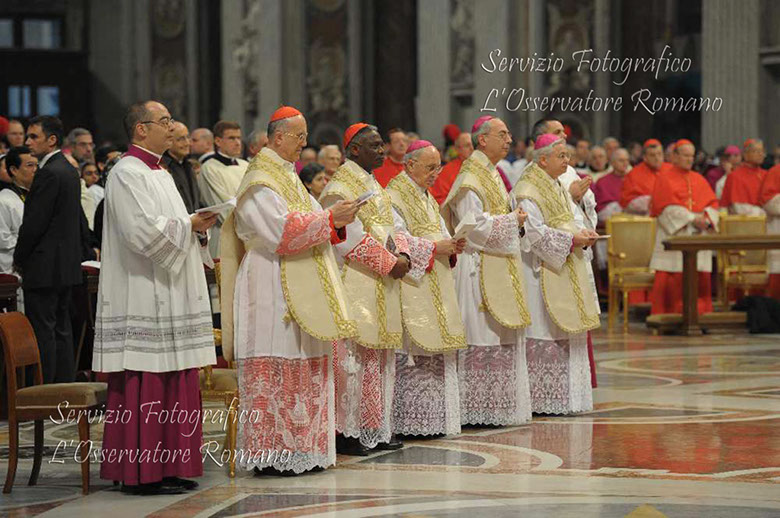
CONGRATULATIONS TO ARCHBISHOP RAYMOND BURKE

soon to be elevated to the

COLLEGE OF CARDINALS

 
click to enlarge


Archbishop Burke has been a long time friend and supporter of the Confraternity of Catholic Clergy. When we had our annual convocation in Saint Louis, his last year before being transferred to Rome, the CCC was called the "Burke's Brigade" by a national Catholic newspaper. When the CCC and ACCC met in Rome this past January for the Year for Priests, His Grace celebrated Latin Mass (Ordinary Form) at Saint Peter's Basilica for us AND he gave us a private tour of the Apostolic Signatura. His pro-life credentials and orthodoxy are impeccable and if there were ever a front-runner and exceptional candidate for the first American Pope, it would be Cardinal Elect Burke. Of course, we hope and pray that Pope Benedict XVI still has a long reign before that takes place.

Yours truly is in picture 3, (far left, how ironic) being one of the principal concelebrants with Archbishop Burke at San Pietro's.
Father Bob Levis is in picture 5 with His Grace while in Saint Louis.
Father Ken Brighenti (far right) and Father Mark Withoos with Archbishop Burke in photo 6 at the Signatura.

Sunday, October 03, 2010

Cena Domenica


boeuf bourguignon and risotto milanese

Fr Brighenti cooked the former and I the latter. While perhaps not the caliber of Fr Z's culinary talent, we did a decent job, I must say for ourselves.  I used arborio rice (1lb or 2c) cooked with 1 chopped onion and 4tblsp olive oil, pinch of saffron, 1c white wine and 56oz of low sodium chicken stock. Finished off with 1/2c shaved Parmisan cheese and sprinkling of parsley.  Took 30 minutes to cook on stove, stirring in two ladles of stock at a time and waiting to be absorbed. Nice Chianti and home made bread along with a delicious lobster cocktail as appetizer and fresh pistacchio gelato rounded off the dinner with our doctor friends.

risotto serves 6-8 (298 calories, 8.3g fat of which 2.8 saturated, 39 carbs and 0.7g fiber, 5.1g protein per serving)

Friday, October 01, 2010

Fr Z succinct


Father Zuhlsdorf splendidly explains the use of the maniple and crossing the priest stole (X) over the chest underneath the chasuble. Like the biretta, these things were no longer obligatory but neither were they proscribed or suppressed. Options are precisely that, things which may or may not be done or used at the discretion of the celebrant. Ad orientem is a major example. Rome has decreed that any priest may celebrate Mass either ad orientem or versus populum. The faithful have the option to receive Holy Communion on the tongue and to kneel while receiving just as they have the option of going to Confession annonymously. Yet, some imperious liturgy experts repudiate such legitimate exercise of freedom and unilaterally and illicitly decide to deny people their rights. As pastor, I did take a month (four weekends) to explain and prepare my parishioners for the monthly experience of ad orientem worship. We also incorporated kneelers (prie dieux) at Communion time for those who OPT to kneel. No one is forced to stand or kneel. My two churches only hold 125 comfortably and we could not locate the old altar rails, so I place two kneelers in front of the sanctuary at Communion time (just as one sees at Papal Masses celebrated by Pope B16)  During the month of preparation, I explained the use of six candles ON the altar with a Crucifix facing the priest (distinct from the wall Crucifix facing the people), the kneelers and the option of the celebrant to offer Mass ad orientem.  When the faithful are treated respectfully like intelligent adults, they respond as such. When you treat them like unsophisticated and unlearned children, you get another response.

I found that when priests and deacons take time to explain (catechize), people appreciate it immensely. This was NOT done after Vatican II in many parishes and dioceses. While the bishops were still in Rome attending Council sessions, liturgical nazis began weaving their web of deceit and invoking the infamous 'spirit of V2' to usher in any and all kinds of innovations, abberations and suppressions which the Bishops and Pope never intended. The people were treated like kindergarden students and told to 'be open.'

With the revised and improved English translation of the Roman Missal coming out next Advent (2011), it gives parish priests the opportunity to educate the faithful but in a mature, respectful and edified fashion. Many of our parishioners have college degrees and are well read in many disciplines. Thanks to EWTN, Catholic Answers Radio, Ignatius Press, and Catholic blogs and websites, we have a sophisticated laity which deserves better treatment than they have been given in the past. I do not find revolutionaries seeking to impose democracy on a hierarchical church, rather, I see educated faithful asking to be treated with due respect and consideration so their obedience will be intelligent as well as deliberate. People want to obey the Pope and Magisterium but can only do so when they are told precisely and ACCURATELY what it is they are to do. Dissidents will always try to sew seeds of discontent, but they are an extreme minority. The bulk of believers WANT to know the full deposit of faith and they deserve nothing less. Likewise, they want licit, valid and reverent Sacraments. They deserve nothing less. We clergy have an obligation to properly PREPARE our people for lex orandi just as we must for lex credendi.

No need to shock or surprise people in the pews. Using the bulletin and pulpit, pastors can and ought to take time and effort to inform God's People what and why we do what we do. I spend five minutes before every Baptism explaining all the symbols and rituals used before we begin so the family and friends can appreciate what is happening and not be clueless spectators. Likewise, at funerals, explaining the incense, funeral pall, holy water, Paschal candle, vestments, etc., help both Catholic and non-Catholic alike appreciate the beauty and elegance of a Catholic funeral. This can be easily and prudently incorporated into the homily before or after one expounds on Sacred Scripture and the Catholic belief on life after death, praying for the dead, et al.

Whenever we restore or return something which was abandoned in the past, it is important to tell the faithful WHY we are doing it. Even if it is mere personal choice, people like to know. If they know Father has a choice (not of what color to wear but what design, Roman or Gothic), what is wrong in letting them know I am exercising my prerogative just as they did in choosing what clothes to put on before coming to church?

Whether it is Ordinary or Extraordinary, Traditonal or Contemporary, Latin or English, the important thing for clergy is to educate our faithful as to what is necessary and what is optional; what constitutes validity and liceity. DE GUSTIBUS NON DISPUTANDUM EST. Hence, my choice of options may differ with my colleagues and/or some of my parishioners. Rather than confusing everyone, if I take the time and make the effort to EXPLAIN using charitable, intelligent and prudent language, you would be surprised the POSITIVE reaction and response you get.

Tuesday, September 21, 2010

It may not be 100% accurate, but it is completely interesting

SAINT MATTHEW THE APOSTLE

September 21
from The Golden Legend


Matthew was also called Levi. Matthew is interpreted a gift hastily given, or a giver of counsel. Or it comes from magnus, great, and Theos, God, meaning great unto God, or from manus, hand, and Theos, meaning the hand of God. For Matthew was a gift hastily given by reason of his speedy conversion, a giver of counsel by his salutary preaching, great unto God by the perfection of his life and the hand of God by his writing of the Gospel. Levi is interpreted assumed, or united, or added, or attached; for he was assumed from the exaction of the taxes, united to the apostles, added to the number of the evangelists, and attached to the catalogue of the martyrs.

While Matthew the apostle was preaching in Ethiopia, in a city called Nadaber, he found two magicians named Zaroes and Arphaxat, who so deluded men by their sorceries that they lost the use of their limbs and their reason, whereat the magicians were so filled with pride that they made men worship them as gods. Matthew, having found hostel in the house of that eunuch of Queen Candace who was baptized by Philip, unmasked the magicians' tricks in such wise that whatsoever they wrought to the harm of men, he converted to their welfare.

The eunuch asked Saint Matthew how he was able to speak and understand so many tongues. In answer, Matthew explained to him that when the Holy Ghost came upon the apostles, He gave knowledge of all tongues, so that, as those who had sought from pride to build a tower reaching to Heaven had been stayed therefrom by the confusion of tongues, so by the knowledge of tongues the apostles might build a tower, not of stones but of virtues, whereby all who believed might mount to Heaven.

Then came one who announced that the magicians were approaching with two dragons, which belched forth a sulphurous fire from their mouths and nostrils, and slew all within reach. The apostle, arming himself with the sign of the cross, went out to them confidently; and as soon as the dragons saw him, they fell asleep at his feet. Then said he to the sorcerers: 'Where then is your skill! Awaken them if you can: for had I not prayed the Lord, I should have turned upon you the bale which you thought to inflict upon me!' And when the populace gathered together, he commanded the dragons in the name of Jesus to go away, and they went off, harming no one.

Then the apostle preached a wondrous sermon to the people concerning the earthly paradise. He said that it was higher than all mountains and near to Heaven; no thorns or brambles grew therein, nor did the lilies and the roses wittier; there was no old age, all men remaining ever young; there the angels made sweet music, and the birds came at one's call. He said that man had been driven out of the earthly paradise, but that by the birth of Christ all were called again to the heavenly Paradise.

As he spoke these things to the people, a loud cry of mourning broke out for the king's son, who had died. When the sorcerers were unable to raise him to life, they persuaded the king that his son had been taken up into the company of the gods, and that he should build a temple and make an image in his honour. But the aforementioned eunuch caused the magicians to be taken prisoners, and summoned the apostle, who prayed over the youth and restored him to life. At this the king, whose name was Egippus, sent heralds throughout his realm, proclaiming: 'Come and see God hiding in the form of a man!' They came therefore with golden crowns and divers kinds of victims, wishing to sacrifice to him. But Matthew forbade them, saying: 'Men, what do ye? I am not a god, but the servant of Jesus Christ!' At his command they then used their offerings of gold and silver to build a great church, which they erected within thirty days; and in this church the apostle presided for three and thirty years, and converted all of Egypt to the faith; and King Egippus was baptized with his wife and all the people. The apostle also dedicated the king's daughter Ephigenia to God, and set her over more than two hundred virgins.

Some time later Hirtacus succeeded the king, and, lusting after the virgin Ephigenia, promised the apostle the half of his kingdom if he would prevail upon her to become his wife. The apostle answered that, following the usage of his predecessor, he should come to the church on the following Sunday, and there, in the presence of Ephigenia and the other virgins, hear how good was godly matrimony. Thither the king hastened with joy, thinking that the apostle meant to urge Ephigenia to marry. Matthew therefore preached for a long time to the virgins and the assembled populace concerning the good of matrimony; wherefore he was much praised by the king, Then, commanding silence, the apostle continued: Since marriage is a good thing, ve who are present well know that if a servant dared to molest the king's spouse, he would deserve not only the king's displeasure, but death besides; and this not because he wished to take a wife, but because he violated the king's marriage by carrying off his wife. And thou, 0 king, who knowest that Ephigenia is espoused to the eternal King, how canst thou purloin the spouse of One mightier than thou, and take her to wife?'

When he heard these words, the king was consumed with rage, and went out of the church, while the apostle, intrepid and unmoved, exhorted all to patience and constancy, and blessed Ephigenia and the other virgins, who had prostrated themselves in his feet. After the Mass the king sent a swordsman, who came behind Matthew as he stood at the altar with his hands raised to Heaven in prayer, drove his sword into his back, and so consummated the apostle's martyrdom.

When the populace heard these tidings, they ran to the king's palace to set it afire, but were restrained by the priests and deacons and made gladsome celebration for the saint's martyrdom. Meanwhile the king could not bend Ephigenia to his will, either by matrons whom he despatched to her, or by the artifices of the magicians. He therefore heaped up a great fire about her house in order to destroy her and the other virgins; but the apostle appeared to them, and warded the flames from the house, and it swept the royal palace and burned it to the ground, the king and his only son barely escaping. Thereupon the king's son was seized by the Devil, and sped to the apostle's tomb, loudly proclaiming his father's sins; while the infamous father was stricken with an incurable leprosy, and killed himself with his own sword.

The people then chose Ephigenia's brother, who had been baptized by the apostle, to be their king. He reigned for seventy years, and then gave his throne to his son. He enhanced the Christian worship lavishly, and filled the whole province of Egypt with the churches of Christ. As for Zaroes and Arphaxat, they fled to Persia the very day that Matthew raised the king's son to life, but there Simon and Jude vanquished them.

Friday, September 17, 2010

The Spirit of V2 is in the LETTER of V2

Pontiff and Monarch Meet


Tuesday, September 14, 2010

We adore Thee O Christ and we praise Thee, because by Thy Holy Cross Thou hast redeemed the world


Feast of the Holy Cross

Today, Holy Mother Church celebrates the Finding and the the Exaltation of the Cross of Christ. Both events occured three centuries apart. The Mediaeval tale of the Golden Legend tells of the discovery of the True Cross by Saint Helena, Empress and mother of the Emperor Constantine, in 326, and of the return of the Cross by the Christian Emperor Heraclius in 629 after it had been stolen by the Persian King Chosroes in 613.

PRE-HISTORY LEGEND OF THE CROSS:

Adam and Eve ate from the Tree of Knowledge of Good and Evil. Cast out of Garden of Paradise. After Cain killed Abel, Adam and Eve had another son, Seth, who placed some seeds from the Tree of Life into the mouth of his father Adam when he died and was buried.


A sapling grew from the grave and a great tree formed. From the branch of that tree, Moses got his staff which he used to part the waters of the Red Sea.

After his death, the staff was taken by Aaron and buried with him. It grew into another tree which King David used in his royal garden.

Cut down for Solomon’s Temple, it would not fit and was cast aside and thrown into a lake. The wood floated to the top and became a natural bridge.

The Queen of Sheba was unable to cross the bridge and had to take off her shoes and wade through the stream. She convinced King Solomon to take the wood and use it as a lintel over the doorway to the Temple. He did this and covered the wood with gold and silver.

His wicked grandson, Abijah, stripped the gold and silver and jewels from the wood and cast it into the water again. This time the wood transformed the waters into the healing pool of Bethesda.

At the time of the Crucifixion, it floated to the top and was washed ashore where a Roman soldier fashioned it into the Cross upon which Christ would be crucified.

It is said that the cross was made out of four kinds of wood, namely, palmwood, cedar, cypress, and olivewood. Hence the verse:

Ligna crucis palma, cedrus, cypressus, oliva.

There were four wooden parts to the cross-the upright shaft, the crossbeam, the tablet above, and the block into which the cross was fixed, or, as Gregory of Tours says, the crosspiece that supported Christ's feet. Hence each of these parts might be made of any of the kinds of wood enumerated above.

FINDING THE CROSS LEGEND:

Roman soldiers found three crosses buried and took them forthwith to the queen (St. Helena). Since they had no way of distinguishing Christ's cross from those of the thieves, they placed them in the centre of the city and waited for the Lord to manifest his glory; and behold! At about the ninth hour the body of a young man was being carried past, and Judas halted the cortege. He held the first cross and the second over the body, but nothing happened. Then he extended the third cross, and the dead man immediately came back to life. In the histories of the Church we also read that when one of the leading women in the city lay close to death, Macarius, the bishop of Jerusalem, brought in first one and then another of the crosses, to no effect; but when he placed the third beside the lady, she opened her eyes at once and rose up cured.
The feast of the Exaltation of the Holy Cross is solemnly celebrated by the Church because on that day the Christian faith itself was exalted to the heights. In the year A.D. 615, the Lord allowing his people to be scourged by the savagery of the pagans, Chosroes, king of the Persians, subjected all the earth's kingdoms to his rule. When he came to Jerusalem, however, he withdrew in fear from the sepulchre of the Lord but took away a piece of the holy cross that Saint Helena had left there. Chosroes wanted to be worshiped as God. He built a gold and silver tower studded with jewels, and placed in it images of the sun, the moon, and the stars. Bringing water to the top of the tower through hidden pipes, he poured down water as God pours rain, and in an underground cave he had horses pulling chariots around in a circle to shake the tower and produce a noise like thunder. Then he abdicated his kingdom in favour of his son and, profane as he was, settled himself in the tower as in a fane, put the Lord's cross at his side, and decreed that all should call him God. Indeed, we read in the book On the Mitral Office that he sat on a throne in the shrine as the Father, put the wood of the cross on his right in place of the Son, and a cock on his left in place of the Holy Spirit. He commanded that he be called the Father.

RESTORATION OF THE CROSS

Emperor Heraclius now marshalled a large army and marched against the son of Chosroes to confront him at the Danube River. Finally the two princes agreed to meet in single combat on the bridge that crossed the river, the victor to take over the empire, both armies being spared any damage. It was also decreed that anyone who came to the assistance of his prince would have his legs and arms cut off and be thrown into the river.

Heraclius offered himself totally to God and commended himself to the holy cross with all the devotion of which he was capable. The two princes fought for a long time, and the Lord granted victory to Heraclius, who thus made the opposing army subject to his command, with the result that all Chosroes's people acknowledged the Christian faith and received holy baptism. Chosroes himself knew nothing of the outcome of the war, because he was hated by all and no one told him about it.

Heraclius journeyed to Chosroes and found him seated on his golden throne. He said to him: "Because you have honoured the wood of the holy cross in your own way, you will be spared your life and your reign on condition that you accept the Christian faith and receive baptism, a few hostages being taken as guarantee. If on the other hand, you consider this beneath you, I will kill you with my sword and cut off your head." Chosroes refused the offer and Heraclius promptly decapitated him; but, since he had been a king, he was given suitable burial. Heraclius found the king's son, a child ten years of age, with him. He had the boy baptised and with his own hands lifted him from the font, then left his father's kingdom to him. But he demolished the tower and allotted the silver to his army as spoils of war, reserving the gold and the jewels for the rebuilding of the churches the tyrant had destroyed.

Now Heraclius carried the sacred cross back to Jerusalem. He rode down the Mount of Olives, mounted on his royal palfrey and arrayed in imperial regalia, intending to enter the city by the gate through which Christ had passed on his way to crucifixion. But suddenly the stones of the gateway fell down and locked together, forming an unbroken wall. To the amazement of everyone, an angel of the Lord, carrying a cross in his hands, appeared above the wall and said: "When the King of heaven passed through this gate to suffer death, there was no royal pomp. He rode a lowly ass, to leave an example of humility to his worshipers." With those words the angel vanished.

The emperor shed tears, took off his boots and stripped down to his shirt, received the cross of the Lord into his hands, and humbly carried it toward the gate. The hardness of the stones felt the force of a command from heaven, and the gateway raised itself from the ground and opened wide to allow passage to those entering. And a most sweet odour, which, from the day and moment when the sacred cross was taken out of Chosroes's tower, had glided across the far reaches of land from Persia to Jerusalem, now made itself felt, and refreshed with the wonder of its perfume all who sensed it. Then the truly devout emperor burst forth in praise of the cross: "O cross, more splendid than all the heavenly bodies, renowned throughout the world, deserving of all men's love, holier than all things else! O cross, you were worthy to carry the ransom of the world! O sweet wood, sweet nails, sweet sword, sweet lance, you were the bearer of sweet burdens! Save the host gathered today in praise of you and signed with your banner!"

Thus it was that the precious cross was brought back to its place, and the miracles of old began again: dead men were raised to life, four paralytics were cured, ten lepers were made clean, fifteen blind people received their sight, demons were driven out, and great numbers were delivered of various infirmities. Heraclius also repaired the churches and endowed them richly. Then he went back to his own land.


My Blog List

Blog Archive